

Quick answer
How do you choose high traffic lounge furniture?
Describe the setting's activities, contacts, spills, movement and care process before comparing products. Review the complete proposed chair or sofa, request relevant configuration-specific records, check cleaning access and establish supported service and replacement options. Use a representative sample and written acceptance log to close gaps. A fabric abrasion number, heavy-duty label or photograph does not establish whole-product durability, a universal lifespan or suitability for every commercial space.
Turn high-traffic use into verifiable selection conditions
Use observed site conditions where available and identify assumptions where the space is new. These rows are requirements to discuss, not universal performance thresholds or MENBRO product claims.
- Named configuration and intended use
- Structure, joints, base and visible condition
- Reports limited to identified subjects
- Exact upholstery and exposed finishes
- Access to seams, gaps and floor contacts
- Confirmed product/material instructions
- Supported parts and responsible route
- Withdrawal and alternative seating
- Recorded return-to-use decision
| Use condition | What to request | What to observe or record | Decision consequence |
|---|---|---|---|
| Repeated arrival and short waiting | Proposed product and intended-use statement | Entry, sitting, rising and local congestion | Compare arrangements against the actual activities |
| Frequent contact at arms and seat edges | Construction/finish information and relevant records | Contact points, seams, edges and exposed junctions | Resolve unsupported claims before selection |
| Bags, footwear and nearby circulation | Base, floor-contact and handling information | Likely scuff locations and furniture movement | Coordinate placement and care responsibilities |
| Drinks, food or other site-specific soils | Exact material identity and applicable care instructions | Where spills could reach seams, gaps and adjacent finishes | Confirm the proposed care process or change the proposal |
| Routine cleaning operations | Product/material method and access requirements | Reach behind, beneath and between actual pieces | Avoid a scheme that depends on unsupported treatment |
| Repositioning or room reset | Permitted handling and assembly instructions | Who moves the furniture and how it is identified | Choose a supported operating arrangement |
| An item unavailable for use | Confirmed service route and any supported components | Removal, replacement, alternative seats and reopening owner | Compare interruption as well as purchase coverage |
| Tender and receiving documentation | Named configuration, reports and written terms | Subject, method/edition, coverage and unresolved differences | Accept, revise or hold with an accountable decision |
Look beyond a durable-looking surface
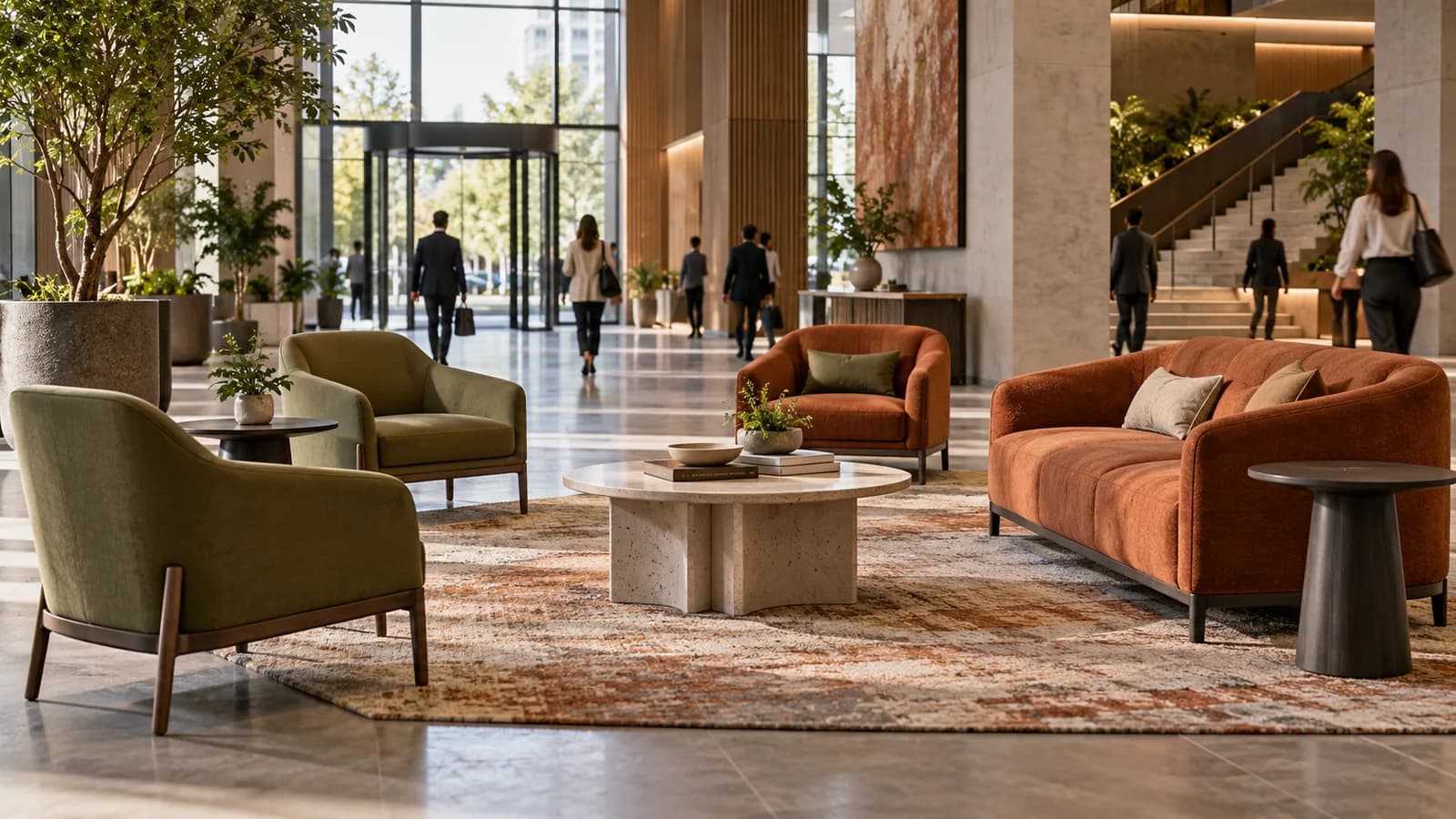
A busy commercial lounge can mean a reception with frequent independent arrivals, a breakout area where furniture is moved, or a lobby with drinks and luggage. These are different conditions. Write down what happens at the location before asking for high-traffic lounge furniture; otherwise two suppliers may answer different briefs while appearing to quote the same requirement.
Describe contact, movement and downtime in ordinary terms
Ask the operator where people touch, place belongings, eat, wait and move furniture. Use available observations rather than inventing visitor totals or a fixed duty category. For a new space, identify assumptions for later review. Include the cleaning team's tasks and the practical consequence of taking a chair or sofa out of use. A quiet-looking photograph cannot answer those operating questions.
Make each concern answerable. Instead of requesting maximum durability, ask for the proposed configuration, the information available for its intended use and the supplier's handling instructions. Instead of requesting easy maintenance, describe the surfaces staff need to reach and their proposed care process. This gives the buyer a way to compare a revised option without assuming that a heavier appearance or darker fabric solves every problem.
Evaluate the complete product and identify the report subject
Review the actual chair or sofa as a combination of frame, connections, suspension, upholstery, legs or base and floor contacts. Ask what construction information and relevant complete-product documentation can be supplied. On a representative sample, record visible condition at junctions, edges and contact points. Do not infer internal construction from photographs or perform improvised load, rocking or impact tests; required testing needs an agreed appropriate method and qualified responsibility.
Keep document identities explicit. Record the report issuer, tested subject, model/configuration, method or standard, edition and stated limitations as applicable. BIFMA's 2025 announcement identifies its reaffirmed public and lounge seating standard; this is context for asking which document covers the proposed product. Naming a standard in an RFQ does not prove conformance, and a report on a different frame, fabric or component does not automatically cover the supplied sofa.
Check surfaces as part of a furniture system
A fabric abrasion result answers a material question under its identified method. It does not describe a seam, an upholstered corner, the suspension below it or the complete chair's service life. Compare exposed finishes, upholstery edges and junctions alongside the material records. Keep the detailed textile-performance discussion in the upholstery specification guide; this selection needs to connect each material claim with the actual furniture and operating conditions.
Review where hands, footwear and luggage are likely to make contact and how any concern will be addressed. A timber leg, metal base or upholstered arm is not automatically suitable or unsuitable because of its material name. Ask for the exact finish and supported information. If a proposed change alters the exposed surface or connection, have the affected documents and sample observations reconsidered rather than retaining an unrelated original claim.
Make cleanability a practical access and compatibility question
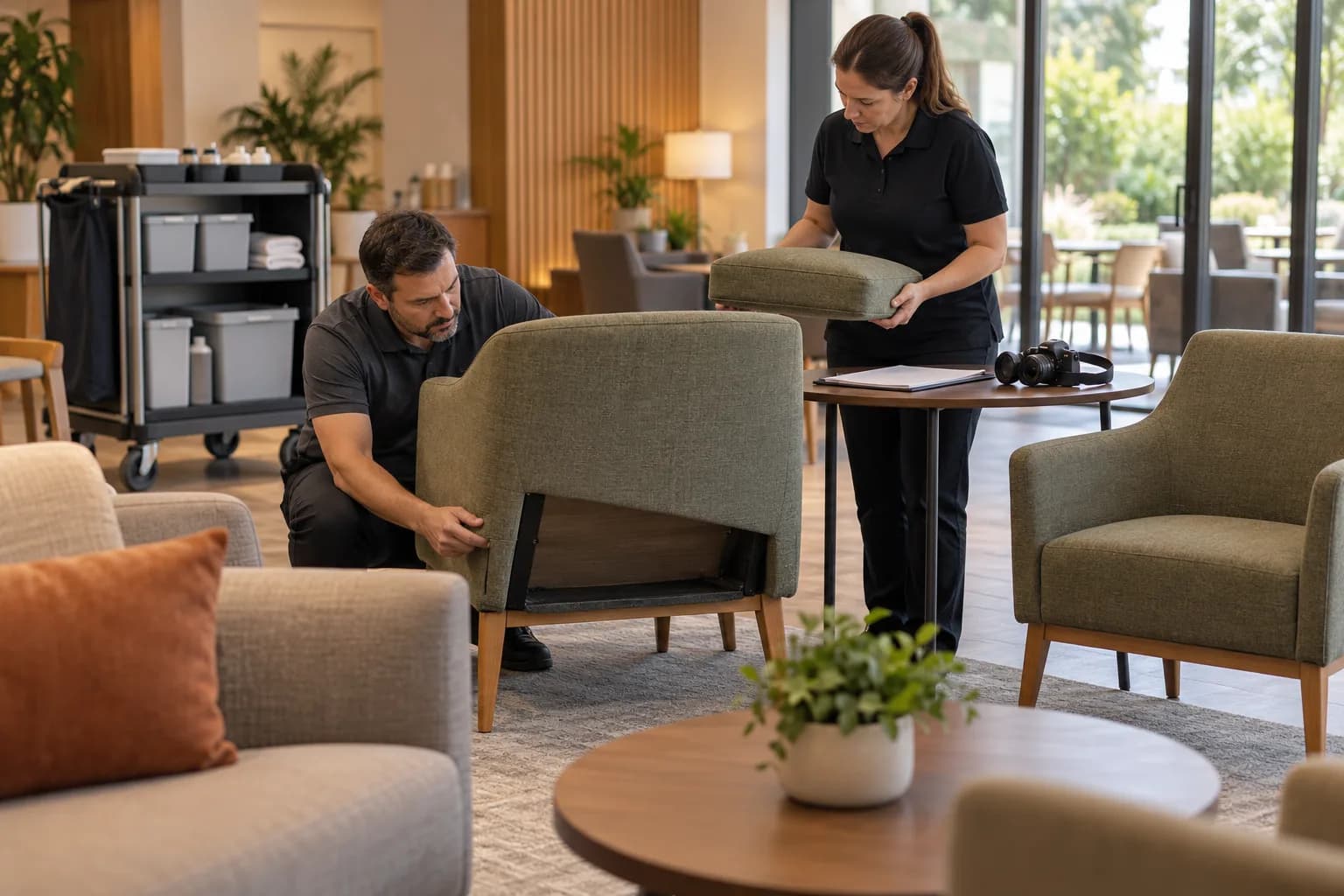
Look behind cushions where access is intended, along seat/back junctions, underneath the base and around nearby tables. Ask staff to describe how they would reach the relevant areas under the selected product's instructions. A neat front elevation may hide an awkward gap or a surface that staff cannot reach in the final layout. Record the issue and ask for a supported alternative or an operating change before purchase.
Match the proposed cleaning process to the exact upholstery and other exposed finishes. Steelcase and Allermuir publish manufacturer-specific care resources; those demonstrate the kind of information to request, not a recipe for MENBRO furniture. Obtain the applicable instructions and resolve conflicts with the site's process. Do not infer that a cleaner suitable for a tabletop is suitable for the upholstery, adhesive, seam or base beside it.
BIFMA's February 2026 announcement describes voluntary surface guidance with commercial as well as healthcare context. Its relevance here is the need to identify the surface, process and document coverage. The announcement is not a MENBRO conformance record or a health claim. Antimicrobial language, a disinfectant association or a test on one material cannot replace the actual care and furniture information required by the project.
Confirm service options and plan for an unavailable seat
Ask which parts, if any, are supported for replacement on the proposed version and who performs the work. Specify the identity required for a service enquiry, the relevant instructions and how availability is confirmed. Herman Miller explicitly describes replaceable cushions on a named lounge product; that is a limited product-specific example. It does not establish that every lounge seat has removable covers, that MENBRO offers those parts or that the example suits your setting.
Compare practical alternatives. One proposal may have a confirmed component-service route; another may require removal of the whole item. Consider how the setting functions during care and how an alternative seat would be provided. Request written terms and current service information without assuming a permanent spare supply, exact future finish match, fixed repair time or warranty duration. Include these differences in the buying decision rather than discovering them after an item is withdrawn.

Build a sample and acceptance record before release
Keep the record attached to the product proposal. Separate an observation, a supported document and an unresolved assumption so the team knows what each decision rests on.
- 1. Describe the operating conditionsRecord location, users' activities, contact and spill exposure, movement, cleaning operations and the consequence of an unavailable seat. Name the operator and facilities reviewer. Mark assumptions for a new site and identify any destination-specific requirements that need the responsible project team's confirmation.
- 2. Define the complete proposalList exact furniture references, configuration, exposed materials and finishes. Request relevant complete-product and material information separately. Ask for instructions, supported service routes and written terms. Keep missing information on the comparison sheet rather than assigning the same heavy-use description to all options.
- 3. Agree the sample reviewIdentify the sample and which proposed features it represents. Use ordinary intended activities and review access for the stated care process. Define required specialist tests separately with the responsible team. An informal showroom observation should not be recorded as a certified durability, chemical or load test.
- 4. Record facts and differencesFor each condition, note the requirement, sample identity, observation or document reference, difference, responsible person and decision. Include dated photographs where useful. Record unavailable or unrepresented details explicitly. A photograph of a matching fabric does not establish the construction, care compatibility or service route of the full product.
- 5. Resolve and selectClassify each issue as accepted, requiring version or held pending information. Ask for a changed proposal, additional suitable documentation or a supported alternative when essential conditions are unresolved. Compare downtime and handling implications alongside appearance. Retain the decision basis without turning a preference into an invented performance result.
- 6. Receive and hand overCheck delivered identities, finish and visible condition against the accepted configuration and receiving plan. Give facilities staff the applicable instructions, asset references, reporting route and supported service information. Follow the site's withdrawal procedure for a concern and retain the responsible service/reopening decision before returning an affected item to use.
What to Check Before You Order
High-traffic commercial lounge RFQ checklist
- Location, activities and observed or assumed use recorded
- Contact, luggage, movement and spill conditions identified
- Exact complete-product configuration and materials listed
- Relevant product and material records requested separately
- Report subjects, methods, editions and limitations checked
- Visible junctions, upholstery edges and floor contacts reviewed
- Care access in the actual arrangement considered
- Proposed cleaning process matched to applicable instructions
- Supported handling and service responsibilities confirmed
- Unavailable-seat plan and replacement assumptions recorded
- Sample identity, observations, gaps and decisions retained
- Receiving checks, asset records and reopening owner assigned
Send a commercial lounge brief the supplier can answer
Share the setting, furniture references, use and care conditions, quantity, destination and required documents. Ask MENBRO to confirm the current proposal, sample route and any supported service options before you rely on them in the project.
See the MENBRO Showroom and Product Range
Watch a short introduction to MENBRO's office chairs, standing desks, lounge furniture and showroom. Ask our team for the current details of any model you are considering.
Frequently Asked Questions
What makes lounge furniture suitable for a high-traffic space?
Suitability depends on the actual use and the complete proposed product: seating activities, contacts, movement, surfaces, cleaning access, maintenance interruption and supported service. Define those requirements, request configuration-specific information and review representative furniture. High traffic is a description of the project, not a universal test result, expected life or promise that a product needs no maintenance.
Does a high fabric abrasion result prove sofa durability?
No. A textile result concerns the identified material and test method. It does not establish the performance of the frame, joints, suspension, seams, legs or complete sofa. Keep material records separate from complete-product documentation, and check that each report identifies the subject and configuration relevant to the proposal. Avoid comparing unlike methods as if their numbers represented a shared furniture lifespan.
Should high-traffic lounge furniture always have removable covers?
Removable covers may be useful where a selected model supports them and the care process benefits from them. They are not automatically required or available. Confirm the removal and refitting method, responsible service route, spare availability and interruption involved. A visible seam or loose-looking cushion does not establish that a cover can be removed, washed or replaced.
Can the site's usual cleaner be used on every furniture surface?
Do not assume that it can. Identify the exact upholstery, finish and other exposed materials, then obtain the applicable furniture and material instructions for the proposed process. Record unresolved compatibility and consult the supplier and responsible facilities team before release. A cleaning guide for another manufacturer's product or one material sample is not permission to treat the complete furniture with that cleaner.
What documents should a commercial lounge buyer request?
Request the named product/configuration specification, relevant complete-product and material records with their stated coverage, current care and handling instructions, confirmed serviceable components and written commercial terms. Identify report subjects, methods or standards, editions and limitations where applicable. A documentation request category is not a certificate, and a material or component record does not certify the entire seat.
How should a damaged lounge chair or sofa be handled?
Follow the site's withdrawal and reporting procedure and the selected product's instructions. Record the asset and configuration, observed condition and relevant photographs, then use the confirmed supplier or qualified service route. Do not improvise structural repairs or return a questionable item solely because it looks acceptable after cleaning. Reopening the seat should follow the responsible team's service and release decision.
What should I include in a MENBRO high-traffic lounge enquiry?
Describe the location, activities, movement and contact patterns, spill exposure, cleaning process, expected service interruption and replacement needs. Attach product references, quantity, destination and required documents or sample checks. Ask MENBRO to confirm the proposed configuration, available information and any supported service options. This guide does not assign a tested duty level, chemical compatibility, warranty or lifespan to an unspecified MENBRO product.
References and Further Reading
These references support the product-selection and technical guidance in this article. Product availability and specifications can vary by model and project.
- Steelcase Interactive Cleaning Guide — Example of manufacturer/material care guidance and facilities coordination; no cleaning recipe adopted.
- Allermuir Materials and Care — Manufacturer maintenance and upholstery-care context; its methods and intervals are not MENBRO instructions.
- Herman Miller Eames Lounge product details — A limited example of an explicitly documented replacement feature, not a general heavy-use recommendation.
- BIFMA public/lounge seating reaffirmation announcement — Dated May 16, 2025; announcement-level standards context, not proof of MENBRO conformance.
- BIFMA furniture surfaces guideline announcement — Dated February 20, 2026; voluntary surface guidance context, not product certification or a health claim.