

Quick answer
How should importers and distributors plan spare parts for commercial furniture?
Start with an installed-base register by product SKU, BOM version and production period. Build a service BOM that assigns each replacement item a agreed identity, compatibility range, criticality, demand basis, reorder point, kit and packaging method, installation authorization and supersession rule. Use actual claim and consumption data to revise quantities. Do not approve a compatible-looking component without confirming interfaces, construction, documentation and the affected finished-product version.
Classify service parts before setting quantities
The groups below organize planning work; they do not prescribe a universal stock percentage or replacement interval.
| Service-part group | Identity and compatibility fields | Planning signal | Release control |
|---|---|---|---|
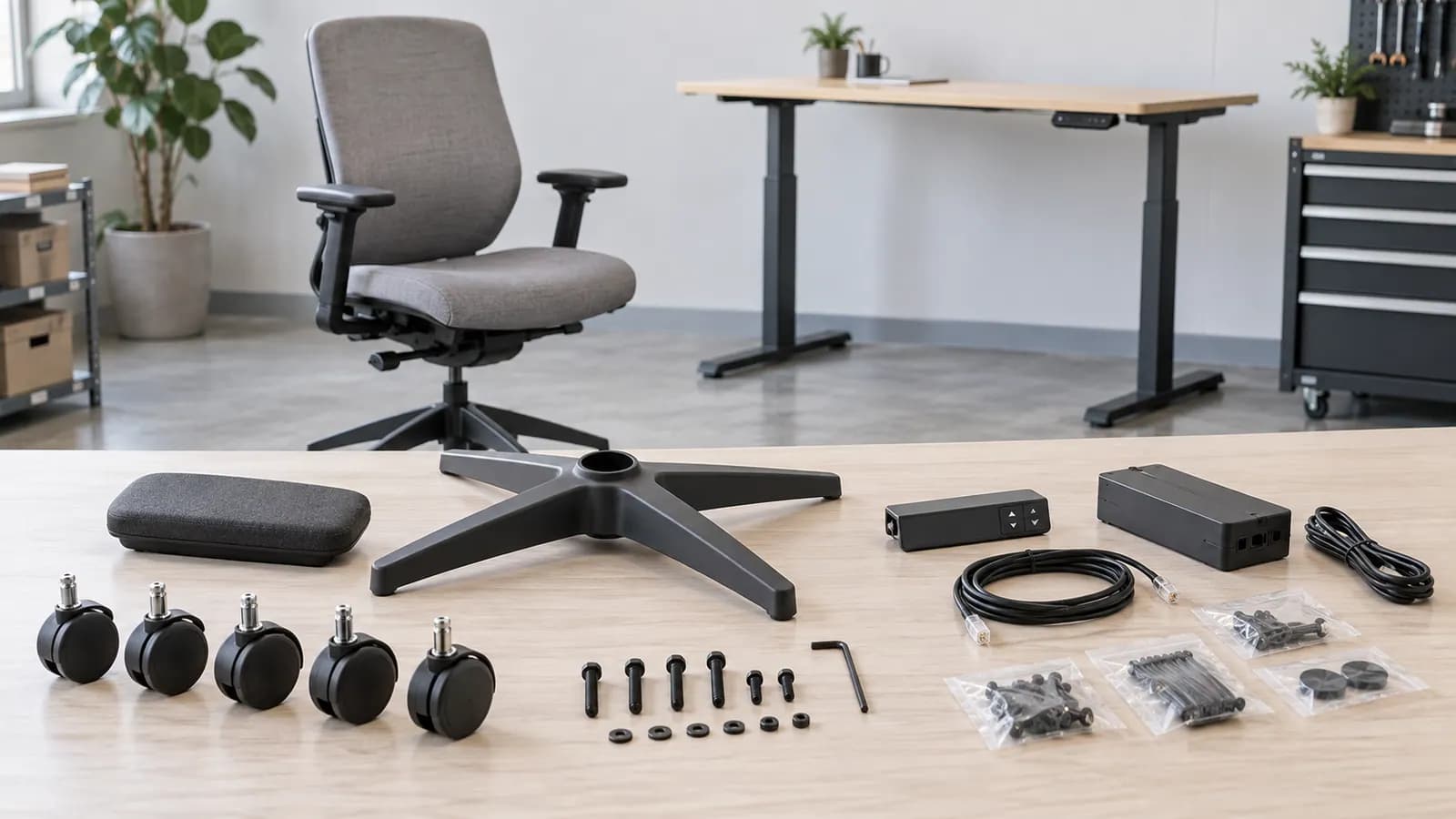
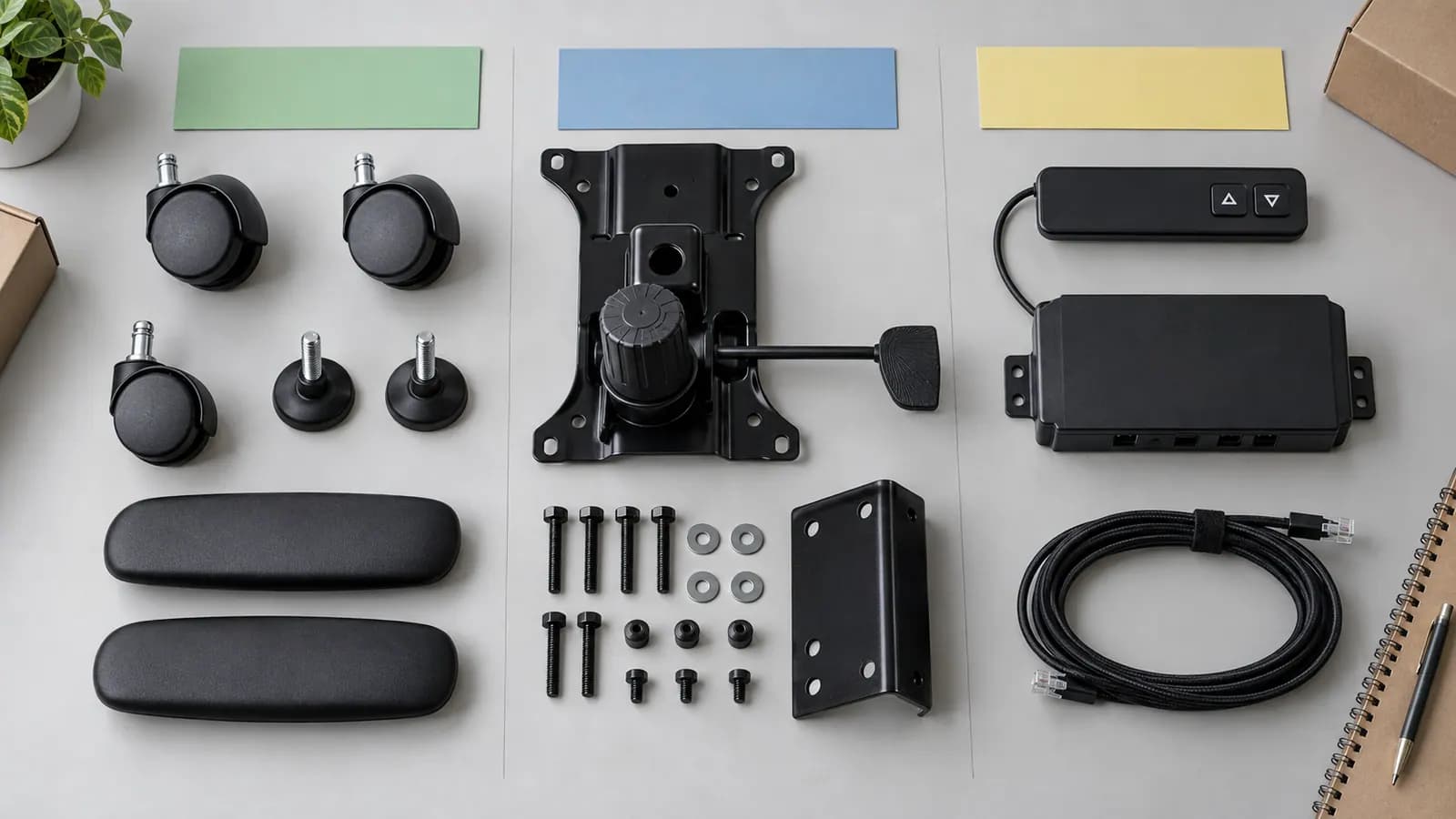
| Routine wear and finish | Caster/glide, arm pad, cover, trim or frequently handled item linked to exact product | Installed quantity, wear pattern, cleaning exposure and service history | Approved color/finish, interface, pack and replacement method |
| Mechanical configuration | Mechanism, base, bracket, fastener or moving part with drawing and version | Failure consequence, observed use and replenishment lead time | Fit check, torque/assembly instruction and finished-product boundary |
| Electrical and version-sensitive | Control box, handset, cable or powered element with supplier part, firmware/version and pinout | Installed generation, fault history and successor availability | Matched system identity; no live test or substitution without authorization |
| Higher verification risk | Structural, stability-related or other part whose incorrect use could affect safety/documentation | Consequence and qualified-service capability, not frequency alone | Restricted installation route and documented compatibility review |
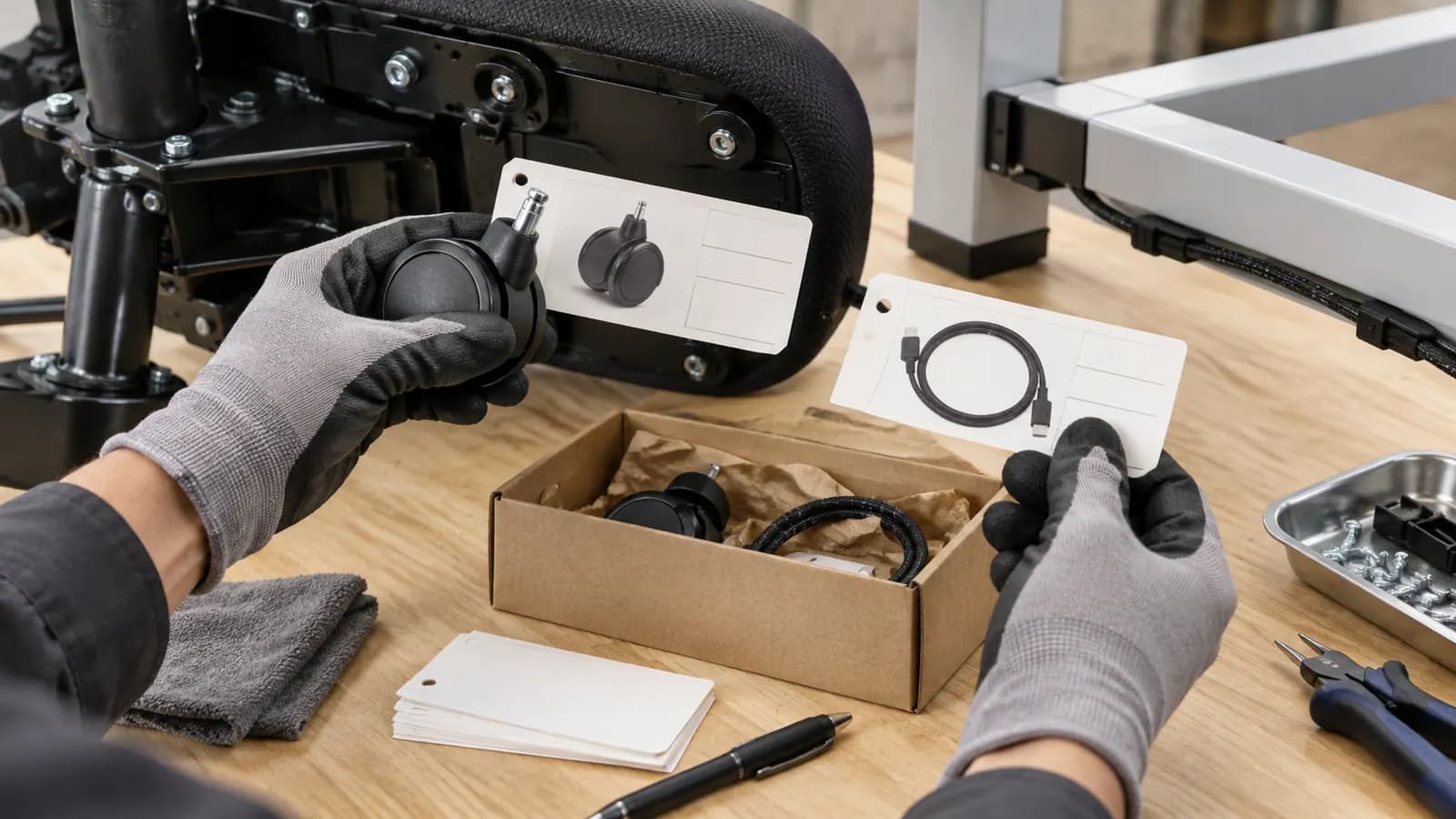
| Service kit and information | Part quantity, fasteners, tools, protection, label and instruction grouped under a kit code | Repair task and field error risk | Pick-pack check, traceable label and complete kit inspection |
Turn the production BOM into an installed-base service record
The production BOM establishes what was released for manufacture, but it is not enough for a distributor answering a field request years later. A service record must translate internal parts into identifiable replacement items, connect them to product revisions and production periods, and state whether they may be installed by a user, dealer or qualified technician. Manufacturer support pages commonly ask for order, model, serial or label information before identifying a replacement; that identity step prevents a visually similar part from being treated as compatible.
Quantity planning should expose assumptions. A useful model considers installed quantity by SKU/version, service and claim history, wear, failure consequence, replenishment lead time, order/pack minimums, storage constraints and the agreed service horizon. Routine wear items, version-sensitive electronics and higher-risk structural components should not receive one blanket percentage. Track issued quantity and reason codes so the next forecast is based on observed demand rather than the first estimate.
Circular-buying guidance strengthens the commercial case for repairable products, accessible fasteners, maintenance information and obtainable parts, but it does not create one universal MENBRO availability promise. For each project, record who owns inventory, where it is held, how a kit is labeled and protected, who may fit it, what documentation or inspection is required and how an end-of-life or successor item is approved without breaking product traceability.
Build a commercial furniture spare-parts plan in eight gates
Keep product identity, service demand and replacement authorization connected from the first shipment onward.
- 1. Define the service promiseAgree the covered products, markets, responsible parties, service channel, planning horizon and response objective without assuming an unstated warranty or availability period.
- 2. Register the installed baseRecord order, customer/site where appropriate, product SKU, BOM version, production period, quantity and available serial or product-label identifiers.
- 3. Create the service BOMGive every serviceable part or kit a agreed code, description, drawing/specification, supplier identity, pack quantity and applicable product/version range.
- 4. Classify compatibility and riskSeparate routine wear, mechanical, version-sensitive electrical and higher-verification items; define who may authorize and install each group.
- 5. Forecast and position stockUse installed quantity, service history, wear, consequence, lead time and order/pack limits to set initial stock, reorder logic and storage location.
- 6. Release the service kitSpecify part quantity, fasteners, protection, label, instructions, tools and return/disposition steps; inspect the complete pick-pack unit.
- 7. Control successors and substitutionsDocument the affected product range, technical comparison, documentation, sign-off owner, cut-in date and treatment of old inventory before changing a service part.
- 8. Close the feedback loopCapture request reason, failed-part identity, field finding, issued kit, installation outcome and repeat demand so the BOM and forecast can be corrected.
What to Check Before You Order
Spare-parts fields to add to an OEM or distribution brief
- Installed product SKU, BOM version, production period and identifying label fields
- Service-part code, supplier identity, drawing/specification and compatible product range
- Criticality group, installation authorization and verification route
- Initial quantity basis, lead time, pack/MOQ, reorder point and storage owner
- Kit contents, fasteners, protection, labeling, instructions and tools
- Claim/request reason code, issued quantity, finding and installation outcome
- Successor/substitution comparison, documentation, sign-off owner and cut-in record
- Availability, warranty, price, freight and responsibility confirmed in project-specific writing
Connect your installed furniture to a agreed service BOM
Send the product SKU or reference, order/version information, installed quantity, markets, service history, requested parts and planning horizon. MENBRO will review the available project-specific identity, kit, packing and supply route.
See the MENBRO Showroom and Product Range
Watch a short introduction to MENBRO's office chairs, standing desks, lounge furniture and showroom. Ask our team for the current details of any model you are considering.
Frequently Asked Questions
What should a commercial furniture spare-parts plan contain?
Connect each service part to the installed product SKU, BOM version and production period; then record the agreed part identity, compatibility boundary, criticality, forecast quantity, storage and packing method, installation route, substitution rule and supersession status.
Is the production BOM enough for after-sales spare parts?
Usually not by itself. A production BOM says what was built, while a service BOM also needs customer-facing part names, compatibility by product version, kit contents, replacement instructions, packaging, authorization limits and successor-part logic.
How should spare-parts quantities be calculated?
Use the installed quantity by model and version, observed service or claim history, expected wear, failure consequence, replenishment lead time, minimum order or pack quantity, repair capability and service horizon. Keep the assumptions visible instead of applying one percentage to every part.
Can a visually similar furniture part be used as a replacement?
Do not assume so. Dimensions, interfaces, load path, material, firmware, connector pinout or complete-product documentation may differ. Use the approved part identity or a documented successor that has passed the agreed compatibility and change review.
Which furniture parts need tighter service control?
Any part whose incorrect selection or installation could affect structure, stability, adjustment, electrical behavior, fire performance or applicable documentation deserves a defined authorization and verification route. The classification must be made for the exact product and use.
Does MENBRO promise a fixed spare-parts availability period?
No universal period is stated in this guide. Availability, service coverage, quantities, lead time and commercial responsibility must be confirmed in writing for the selected MENBRO SKU, version, order and market.
References and Further Reading
These references support the product-selection and technical guidance in this article. Product availability and specifications can vary by model and project.
- European Commission circular furniture procurement case — Primary public-procurement example covering spare-parts access, disassembly, repair and maintenance information; it is not a MENBRO service commitment.
- Herman Miller Customer Service — Manufacturer support route illustrating the need to identify a product and use controlled service channels.
- Herman Miller Warranty and Service — Manufacturer example requesting order, manufacturing-date or product-label information before service; terms apply only to that company.
- Humanscale replacement-part support — Manufacturer support example requesting serial/order/model and part descriptions to identify replacements.
- Steelcase manufacturer warranty — Manufacturer example showing that service and warranty conditions are product, purchaser and market specific; its terms do not transfer to MENBRO.
- ISO 14009 material circulation — Official ISO project page covering material circulation and design considerations such as assembly and disassembly.
- BIFMA e3 sustainability standard — Primary industry context for furniture sustainability and product stewardship; certification is not implied for a MENBRO SKU.
- MENBRO OEM / ODM — Current MENBRO route for project-specific BOM, service-part, packing and change-control discussion.