

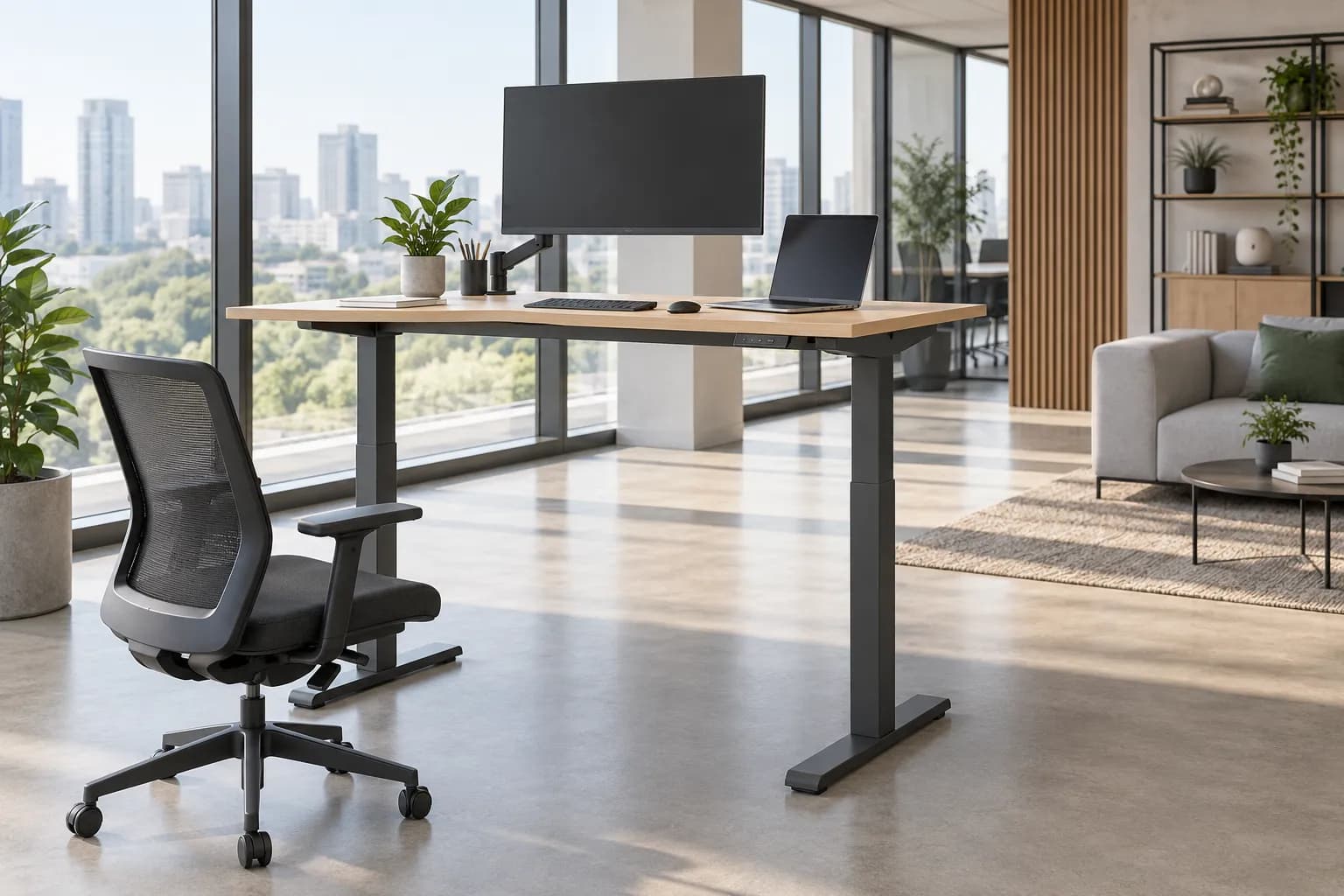
Quick answer
How should buyers check standing-desk stability at full height?
Review the actual configured sample at the intended highest working position. Record the frame and tabletop versions, tabletop size and fixing, equipment and how it is distributed, height, floor and leveling condition, installation state, and front-to-back and side-to-side use observations. Decide against an agreed project record—not an isolated feature, a generic wobble claim or a presumed test result.
Full-height standing-desk review record
This is a project comparison framework, not a universal test method or pass/fail threshold. The useful record keeps the selected desk and its actual conditions together.
- Frame, columns and revision
- Top dimensions, material and fixing
- Equipment and accessory layout
- Working or maximum height
- Floor, glides and installation
- Front/back and side/side use
- Sample observation record
- Agreed acceptance route
- Change-control trigger
| Review area | Why it belongs in the record | What to identify |
|---|---|---|
| Desk identity | A product-family name does not identify the complete sample | Frame, columns, tabletop, fixing method, accessories, equipment and version |
| Height and use | What is felt at a lower setting may differ at the intended highest working position | Stated height, operating position, normal work pattern and whether the desk is shared or fixed |
| Equipment and load layout | The arrangement on the top is part of the reviewed configuration | Monitors, arms, laptop, peripherals, stated load/setup and where items sit on the surface |
| Floor and installation | A level, mounting and support condition should not be assumed | Floor surface, glides or feet, leveling condition, assembly/installation state and nearby interaction |
| Direction of observation | Front-to-back and side-to-side behavior may be experienced differently | Observed use direction, reviewer actions agreed for the project and any context needed to repeat them |
| Decision and change control | A sample observation needs a bounded project outcome | Review owner, sample-record ID, decision, exceptions and changes that require re-review |
Treat stability as a complete desk in a real setting
At full height, a standing desk is the frame, tabletop and installation that a user actually encounters—not a frame specification viewed in isolation. Start with an identity record: the selected frame and version, tabletop dimensions and material, fixing method, monitor arms or other accessories, equipment layout and the intended working height. This is how a later project team can tell what the sample result represents.
The floor and installation belong in the conversation. Check that the desk has been assembled and placed as intended, identify the floor condition and feet or glides, and record any leveling adjustment. Then observe the intended work pattern in both front-to-back and side-to-side directions. A review should describe what was observed under stated conditions; it should not invent a universal movement measurement or promise that a desk will feel identical in every room.
Do not use a visible feature as a shortcut. Four legs, a crossbar, dual motors, a thicker top or larger feet may be relevant design choices in a selected program, but none alone proves a stability result for every configured desk. Tabletop geometry, equipment placement, maximum height, assembly, floor and how people interact with the desk are all part of the project question.
BIFMA describes ANSI/BIFMA X5.5 as a desk and table standard with stability, leg-strength and height-adjustable-surface tests. That is useful context for buyers asking which formal documentation exists, but a project sample review is not the same as asserting a standard result. If a contract requires a particular report, test method or coverage, request it for the selected product and keep it separate from the site or sample observation.
End with a bounded decision. Use the sample record to confirm, revise or escalate the selected configuration. If the top, equipment, mounting, accessories, maximum height, floor assumption or work pattern changes, ask whether the record still represents the supplied desk. That preserves a useful sign-off trail without turning a single observation into an absolute stability promise.
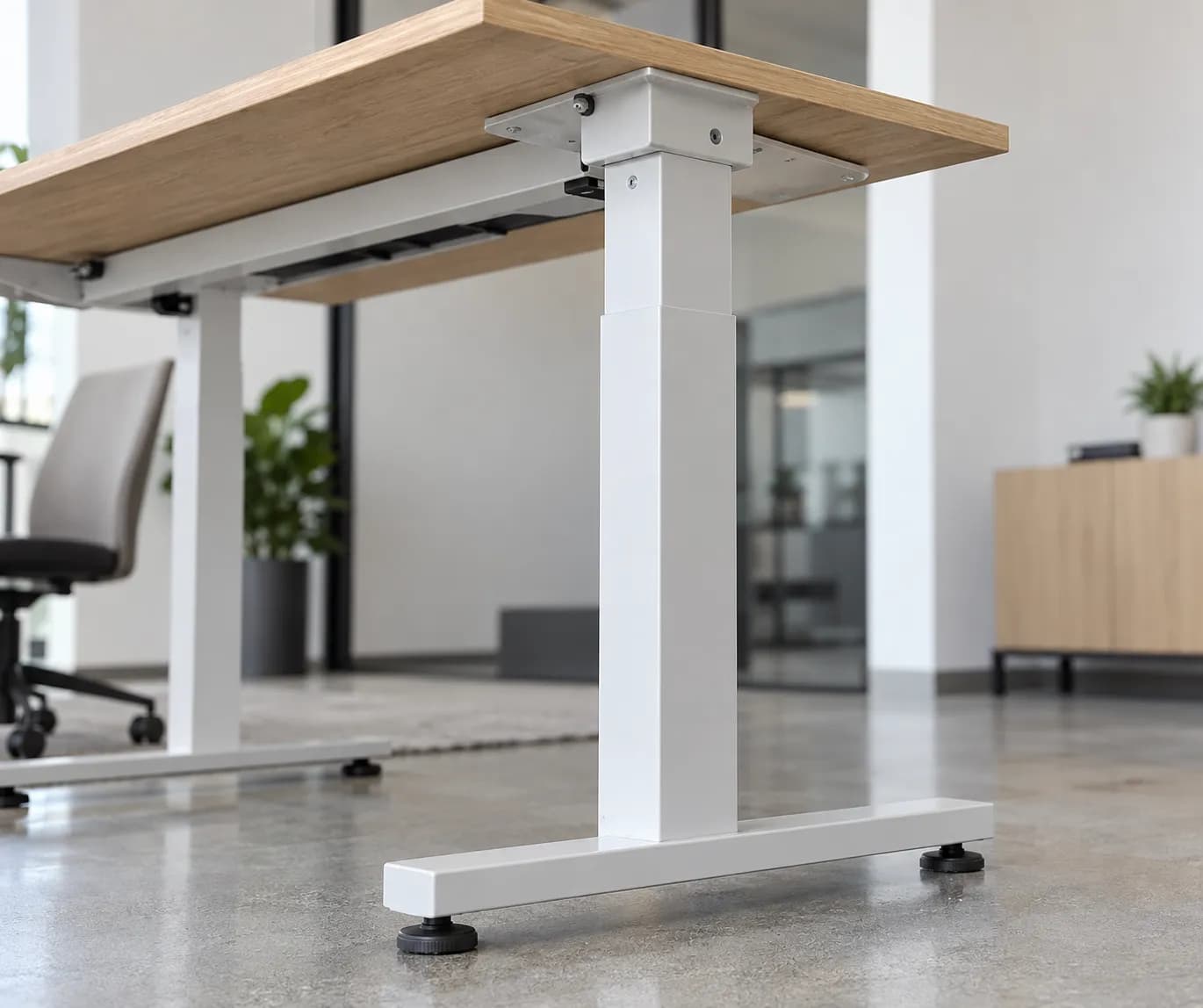
A project route from full-height sample to acceptance record
Agree the configuration before the review, then retain the conditions with the resulting decision so another team can understand the coverage of the observation.
- 1. Freeze the desk identityList the frame and version, tabletop, fixing, accessories, equipment and any intended configuration options before the sample is reviewed.
- 2. Set the full-height conditionState the highest intended working position and the relevant work pattern rather than testing an undefined use case.
- 3. Document setup and supportRecord equipment layout, stated load/setup, floor condition, feet or glides, leveling and installed/assembled condition.
- 4. Observe agreed directionsReview front-to-back and side-to-side use in the agreed sample setting; document observations without converting them into invented numerical claims.
- 5. Compare against the requirementUse the project's stated requirement, sample brief or agreed acceptance rule. Route exceptions to the named technical or commercial owner.
- 6. Release and protect the recordKeep the sample identity, observations, decision and change triggers with the product record before project release or installation.

What to Check Before You Order
Full-height standing-desk sample brief
- Exact desk SKU, frame/column version, tabletop, fixing method and selected accessories
- Tabletop dimensions, material and underside attachments that form the sample
- Equipment list, stated setup/load and placement across the work surface
- Highest intended working position and the stated use pattern
- Floor condition, feet or glides, leveling and installed/assembly state
- Front-to-back and side-to-side observation directions agreed for the project
- Reviewer, date, sample-record ID, notes and supporting material where agreed
- Applicable contract requirement or documentation request, if one exists
- Acceptance, version or escalation owner and next action
- Change triggers for the frame, top, equipment, mounting, height, floor or use pattern
Prepare a full-height desk review brief
Send the intended desk reference, tabletop, equipment layout, maximum working height, floor context, quantity, destination and project documentation request. MENBRO can discuss current configuration options for a project-specific sample review.
See the MENBRO Showroom and Product Range
Watch a short introduction to MENBRO's office chairs, standing desks, lounge furniture and showroom. Ask our team for the current details of any model you are considering.
Frequently Asked Questions
Why should standing-desk stability be reviewed at full height?
Full height may be a decision point because the desk, selected top, equipment, floor, installation and intended use can feel different there than at a lower position. Review the actual configured sample at the intended working height and record the conditions rather than relying on a generic feature claim.
Are four-leg or dual-motor standing desks automatically more stable?
No. Leg count or motor count does not establish the stability of a complete desk in a project. Review the selected frame, top, equipment, load distribution, maximum height, floor, leveling, installation and use direction together.
What should be recorded during a full-height stability review?
Record the exact desk and version, tabletop dimensions and fixing, accessories and equipment, stated load and distribution, maximum or working height, floor and leveling condition, installation state, front-to-back and side-to-side use observations, reviewers and the agreed decision route.
Does a stability observation prove a desk meets a certification?
No. A project observation and a certification or standard test have different coverage. If a contract requires a stated standard, report or laboratory route, define that requirement for the actual product and documentation requested; do not turn this field checklist into a certification claim.
Can a thicker tabletop guarantee less movement?
No. Tabletop thickness alone cannot establish a stability outcome. The complete configured desk, its mounting, equipment, height, floor and intended use all need to be assessed together.
What happens if the configuration changes after a sample is reviewed?
Treat a material change to the frame, tabletop, equipment, mounting, accessories, maximum height, floor assumption or use pattern as a reason to review whether the sample record still represents the supplied desk. Keep the version and change decision visible.
References and Further Reading
These references support the product-selection and technical guidance in this article. Product availability and specifications can vary by model and project.
- BIFMA desk and table standards description — Primary industry context: the desk/table standard includes stability, strength and durability test methods; verify any required evidence and its product scope separately.
- BIFMA X5.5 revision announcement — Primary context that the 2021 revision emphasized stability and height-adjustable desk/table surface tests, without converting this article's checklist into a compliance claim.
- Eureka Ergonomic stability guide — Manufacturer comparison used for its full-height buyer question; this article adds a configuration, floor and acceptance-record framework for commercial projects.
- MENBRO standing-desk load-capacity guide — Related guide for keeping a load statement tied to the selected desk configuration rather than using it as a stability conclusion.