


Quick answer
How do importers compare office chair packaging on a repeat order?
Retrieve the last approved chair and packaging versions, including the real delivered pack and accepted exceptions. Compare them with the new model, variant, parts, shipping state and route. Record the outer carton, inserts, accessory packs, closure, instructions and marks as unchanged, changed or TBC, with a source for each. Review affected fit, protection and document questions with the responsible team, then release only a named packaging version in writing.
Compare last pack, proposed pack and the decision documentation
Use actual version IDs where available. An absent old record or a similar-looking carton is TBC, not documentation that the two packaged products match.
- Chair and pack revisions
- Delivered sample and exception
- Artwork and closure references
- Current product and parts
- Pack and route proposal
- Substitutions and remaining stock
- Fit or representative sample
- Affected validation review
- Written owner and release version
| Comparison line | Last approved reference | Current proposed version | Required decision |
|---|---|---|---|
| Chair identity | Model, finish, component and assembly state | New model and any changed parts | Confirm product fit and exclusions |
| Outer carton | Drawing, material, size and closure version | Actual proposed construction | Review any change with pack owner |
| Inserts and contact | Locations and material identity | Current part separation and contact | Representative fit and surface check |
| Accessory pack | Contents, counts and location | Current hardware, tools and manuals | Reconcile BOM and pack-out |
| Marks and files | Approved barcode, label and manual version | Current market and order files | Proof and written file release |
| Route and documentation | Previous route and test/sample coverage | Present handling and route | Determine affected review or retest |
| Receiving feedback | Shortages, damage and accepted exceptions | Corrective action status | Close issues before reuse |
Recover the last accepted pack before comparing a new one
A repeat order can carry the same chair name while its carton, insert or contents change. The packaging comparison starts with the last approved version, not with a fresh generic export checklist. Ask which product and package specification governed the previous shipment, what physical reference or dated pack-out was retained, and which exceptions the buyer accepted. Where the last order had an issue, identify the correction agreed for this run. If the record is incomplete, mark the baseline as incomplete and decide what new sample or inspection can establish a reliable reference.
Separate the earlier purchase order from the documentation that identifies a packaged product. An order can specify an item and quantity without identifying the foam or fiber insert, hardware pouch location, closure tape or mark version. Request the actual drawing, BOM, artwork file, packing instruction and representative sample where they exist. Compare the delivered pack to those references and record discrepancies. A previous photograph can reveal a visible difference, but it does not show every construction property or prove how the current chair will fit.
Identify the exact chair version that the pack must hold
Record the current SKU, finish, components and supplied assembly state before discussing the box. A changed base, arm, headrest, upholstery or accessory may alter packed geometry, contact risk and contents. Use one line per materially different variant. If the previous pack was made for a different configuration, ask the packing owner whether it remains suitable instead of treating the model-family name as a fit test. List separately packed accessories and multi-carton relationships so the packaging review covers the actual deliverable.
The MB-2118B task-chair and MB-2020C visitor-chair pages below are named MENBRO candidates for model-specific pack questions. They are not documentation that either currently uses a particular carton, insert, closure or shipping state. Ask for each model's current product and package revisions, part list and instructions. A pack approved for one chair cannot be copied to the other because both appear in a chair collection. Keep the intended mix and quantities by version clear for the repeat-order response.
Compare the carton structure and part contact
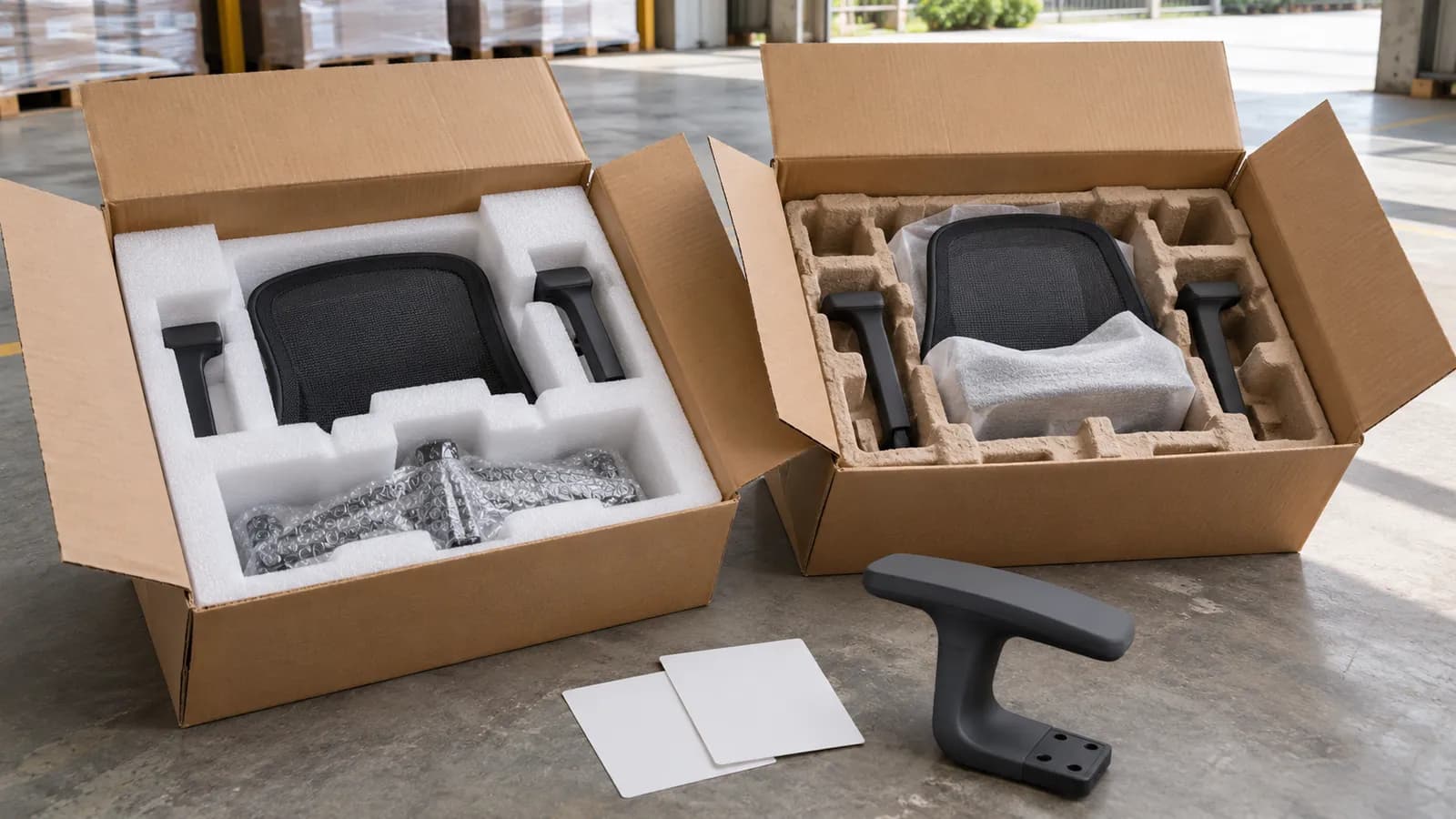
For the outer package, compare the actual construction reference, outside form, closure method, handling marks and any pallet or multi-carton relationship. For the inside, compare every support or separator that keeps parts in a defined location. Ask whether a replacement material, new fold, moved insert or altered closure changes how the chair components meet the packaging. The point is to surface a difference and assign a check; this guide does not prescribe a universal carton board grade, cushioning material, drop height or transport test.
Look at finished surfaces, protruding components, loose hardware and components that can contact one another. Ask the responsible packaging team to compare the complete current pack-out with the approved baseline and to record any change to insertion order or packing process. A material report for an insert does not show that the complete chair pack protects the product on the intended route. A visual similarity is a prompt to check exact specifications, not a basis for describing an altered pack as identical or previously tested.
Reconcile accessories, instructions and carton marks
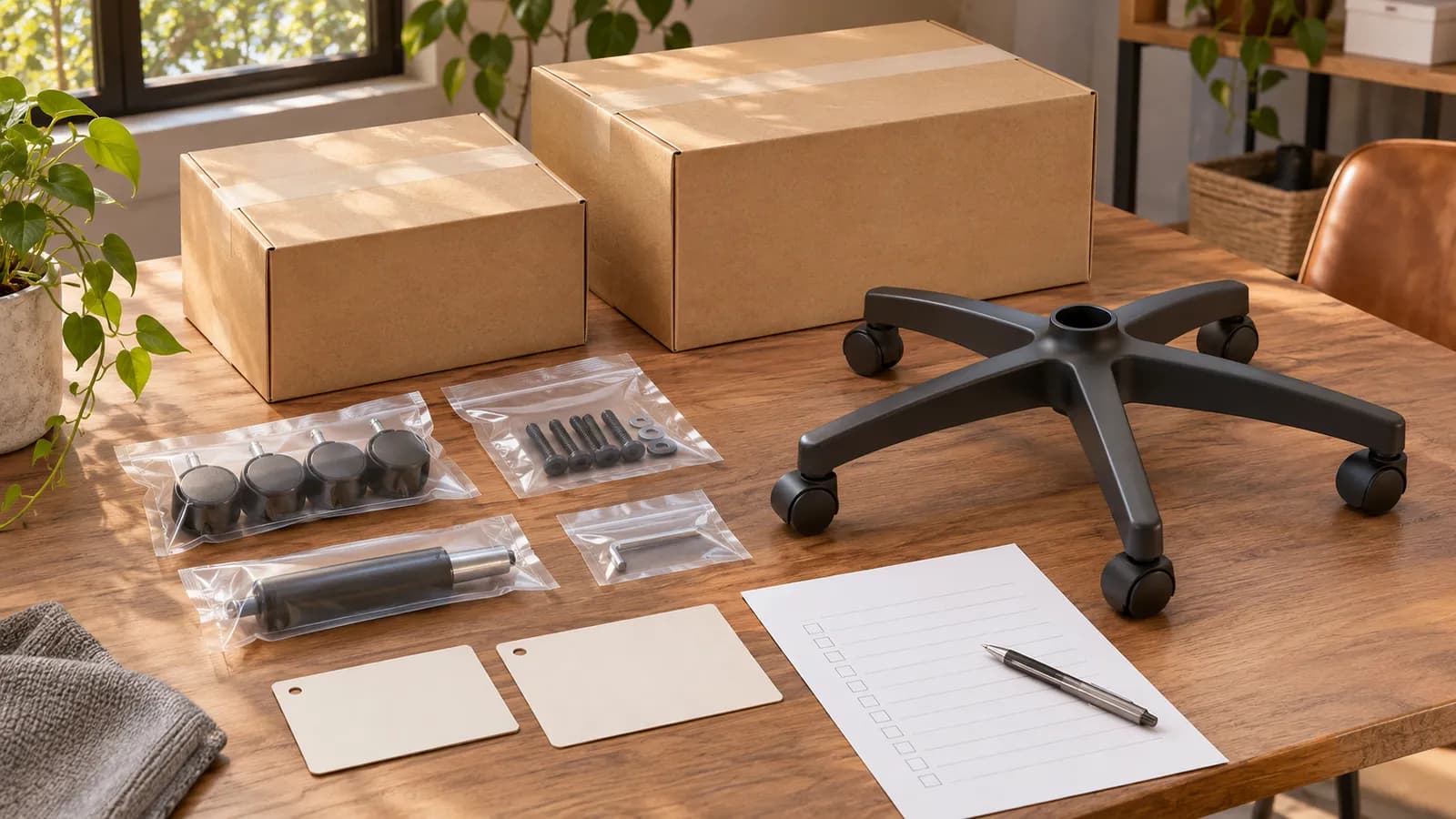
A repeat run can arrive with the right chair parts and the wrong instructions or hardware pack. Compare the BOM and carton contents against the current approved product configuration. Record the quantity, identity and location of tools, fasteners, feet, controls or other supplied accessories as applicable. Ask whether a changed chair version needs a changed manual or service reference. When a part is substituted, the buyer should see which product, instruction and pack references require review before the substitute is used.
Treat labels, barcodes, product identifiers, carton marks and language files as versioned content. The private-label artwork sign-off guide deals with the first full proof process; this article asks whether the exact prior approved files still apply to the repeat pack. State the current destination and brand variant, then compare file IDs and intended placement. If a different market, SKU or carton construction is proposed, request an updated proof and written acceptance. Never infer legal label sufficiency from a reused artwork file.
Do not let spare carton stock hide mixed versions
The supplier may have unused cartons, inserts or printed labels from an earlier run. Ask for each stock item to be identified by version, quantity, condition and intended chair version. Confirm whether the current parts still fit and whether the marks and instructions remain correct. Segregate obsolete or unresolved stock from approved stock in the planning record. A stock count is not permission to use a previous version against a changed chair or destination. Ask the buyer and packing owner for a written use decision where any old stock is proposed.
If two packaging versions will be used in one repeat order, require a line-by-line allocation. The buyer and receiver need to recognize which cartons contain which variant, what changed between packs and whether both have been approved for their intended route. Ask for a distinct identifier and representative pack-out documentation for each version. Do not merge the versions under one vague carton description because that makes later shortages, damage or returns difficult to trace to the pack actually received.
Revisit the route and any previous validation
Compare the earlier distribution route, handling unit and destination with the current proposal. A switch from pallet handling to individual parcel delivery, a different transit path or a new receiving process may make an unchanged physical carton an unverified choice for the new route. State the actual expected route and ask the responsible logistics and packaging teams what review is needed. Previous shipment experience is useful feedback, but it is not a guarantee that every future package will arrive without damage.
ISTA's first-party retesting guidance identifies product, package and process changes as possible reasons to repeat testing when they could affect performance. Ask what exact packaged-product version any prior report covered and who will assess the proposed differences. The answer might be a documented no-impact decision, a representative fit and pack review or a newly selected formal test, according to the responsible team's method and contract. Do not call a changed package tested unless a matching record supports that wording. Retain the decision and its limitations with the pack version.
Use receiving feedback as a change input
Check the last delivery's actual receiving notes before approving a repeat pack. Record carton damage, wetting, part movement, missing accessories, incorrect marks or instructions and the product observations associated with them. Preserve identifiers, photographs and the final disposition where available. Ask whether a corrective action was accepted, whether it changed the product or pack and whether the proposed version includes that change. A complaint alone does not prove root cause; a clean receipt alone does not prove future performance. Both inform the next responsible review.
Define what the new receiver should record: carton and product identity, visible condition, contents count, exception photographs and the channel for reporting a discrepancy. The receiver's record should be able to distinguish the last version from the new one. Keep a later claim or warranty decision within the actual agreement and documentation. This article prepares a agreed comparison and release, not a damage-rate claim or promise of a certain arrival result.
Close every difference before written release
A practical difference log has one line for the old reference, proposed version, source, effect, assigned reviewer and decision. Mark each line unchanged, changed or TBC; give TBC a next action. Reconcile product, package, artwork, instructions, route and accepted corrective actions before asking for sign-off. The purchasing team should know whether it is authorizing an unchanged repeat, a limited version or a new packaged-product configuration. These are decisions for the actual transaction, not universal MENBRO service promises.
Release a named pack version and retain the comparison with the current order. If the buyer changes chair variant, accessory, destination or pack material after release, reopen the affected rows and decide whether the sample or validation reference still applies. At shipment, ask the packing team to record the version actually used and any exception. This gives the distributor a clear reference for receiving and a future reorder without turning a prior label or photograph into documentation it cannot provide.
Products to discuss with MENBRO
Mid-Back Ergonomic Task Chair (MB-2118B)
Request the current chair configuration and matching packed revision for this task-chair candidate. Compare it only with its own previous approved pack and record any affected sample or validation question.
Mid-Back Ergonomic Mesh Cantilever Visitor Chair with White Frame (MB-2020C)
Request a separate packaging identity for this visitor-chair candidate. Confirm its actual parts, assembly state, labels and pack version before including it in a repeat order.
From prior pack to repeat-order release
Each stage leaves a dated reference and an owner, so a later reader can see which pack was approved.
- 1. Recover baselineFind the last approved chair, package, artwork and exception versions, plus receiving feedback.
- 2. Name current supplyList current SKU, variants, parts, assembly state, route and destination.
- 3. Mark differencesCompare carton, insert, accessory, instruction, label, closure and process line by line.
- 4. Assign affected reviewAsk packaging, product, buyer and qualified logistics owners for required fit, proof or validation decisions.
- 5. Reconcile stock and filesIdentify any old packaging stock and current artwork, manuals and carton marks before use.
- 6. Release and traceRecord the approved version, open conditions, actual packing identity and receiving reference.
What to Check Before You Order
Send a chair reorder packaging comparison
- Recover the last controlling product and packaging versions, not only a PO number.
- Link the current SKU and list quantities by chair and packaging variant.
- Compare assembly state, part identities and any separate accessory packs.
- Compare carton construction, internal inserts, closure and handling conditions.
- Match labels, barcodes, private-label files, manuals and current destination.
- List prior receiving issues, corrective actions and proposed old-stock use.
- Ask who will review changed fit, protection, route or test coverage.
- Mark each difference unchanged, changed or TBC, with source, owner and written release.
Editable repeat-order packaging comparison
Work privately; copy and print keep the text you edit. Treat missing records as TBC.
Ask for a versioned chair pack comparison
Send the named chair models, variant quantities, destination, purchase window and last approved pack references. Ask which differences need a representative sample, document or qualified packaging review.
See the MENBRO Showroom and Product Range
Watch a short introduction to MENBRO's office chairs, standing desks, lounge furniture and showroom. Ask our team for the current details of any model you are considering.
Frequently Asked Questions
What is the first step in an office chair reorder packaging check?
Identify the last approved chair and packaging version, including any accepted exceptions. Obtain the actual pack specification and reference sample where available. Compare the new chair configuration and intended distribution route with that baseline before calling the pack unchanged.
Is the last purchase order enough to approve the same chair carton?
No. An order number may point to a product but omit insert, closure, artwork, accessory and exception versions. Request the controlling packaging record and reconcile it with the delivered pack and current proposed configuration.
Which changes need a renewed review?
Record changes to the chair, assembly state, components, inserts, outer carton, closure, labels, manuals, route or packing process. The responsible buyer and packaging team decide what fit, appearance, handling or test documentation is needed for the affected configuration.
Can a similar carton photograph prove the pack is unchanged?
No. Photographs help identify visible details but may not show material construction, part fit, closure method or all carton contents. Match dated photos to drawings, component lists, samples and written version records.
Does an earlier packaging test cover a changed chair pack?
Only the recorded packaged-product configuration and test coverage can be considered. ISTA advises review and retesting when product, package or process changes could affect performance. Ask the responsible team to document its decision for the proposed version; do not assume a new result.
How should mixed old and new packaging stock be handled?
Identify each usable pack by version, product/variant fit, marks and sign-off status. Keep obsolete or unresolved stock separate and ask the responsible buyer and supplier to approve any proposed use in writing. Do not merge versions under one ambiguous carton label.
What should accompany a repeat-order packaging release?
Retain the approved baseline, difference log, matching product and packaging references, representative check or sample coverage, open-item decisions, current artwork and instructions, named approver and version used for the purchase and receiving record.
References and Further Reading
These references support the product-selection and technical guidance in this article. Product availability and specifications can vary by model and project.
- ISTA retesting guidance — First-party guidance on product, package and process changes that may call for retesting.
- MTT packaging reorder guide — Competitor context on retaining approved references and reviewing changed specifications.
- ELAPACK reorder version guide — Competitor context on recovering the approved baseline and requesting revised specifications.
- BrandYourPack reorder checklist — Competitor context on identifying artwork and structural differences.