

Quick answer
What should buyers protect and verify in standing desk export packaging?
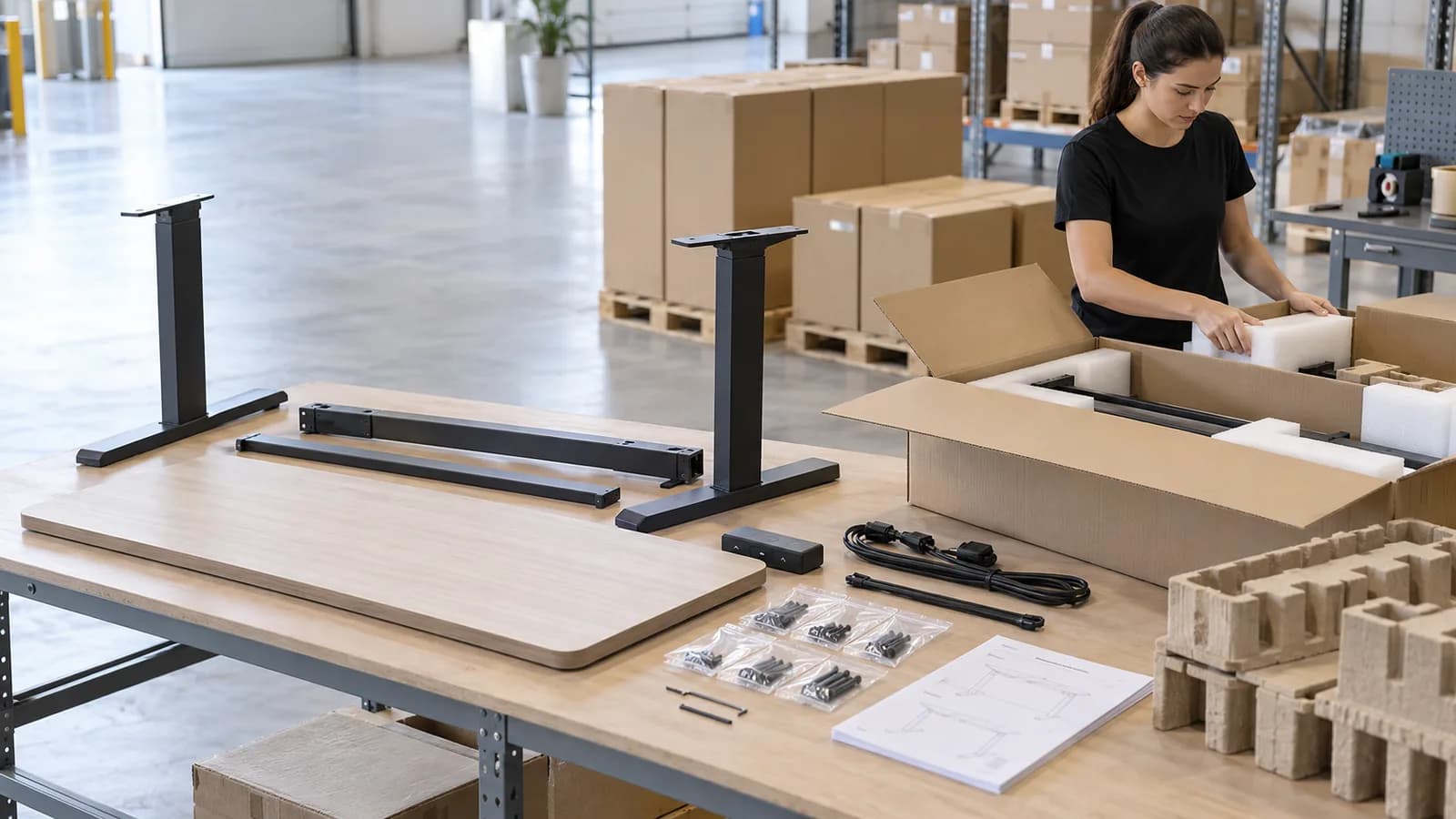
Protect and identify every part of the approved packed configuration: columns, feet and rails; tabletop faces, edges and corners; motors, control box, handset and cables; fasteners, tools, instructions and labels. Immobilize heavy parts, separate contact surfaces, control small items, match every carton to the SKU and pack version, and verify the complete pack-out before closure. Choose any transport test from the actual distribution route, package type, weight and contract requirement—never from a generic test label alone.
Standing desk export packaging risk map
The protection method must be designed for the selected desk and distribution path. The examples below are questions to resolve, not universal material or test specifications.
- Immobilize heavy metal parts
- Protect tabletop faces and edges
- Isolate electronics and cables
- Match carton to SKU and version
- Control hardware and documents
- Mark multi-carton relationships
- Approve a pack-out reference
- Record closure and carton condition
- Link receiving exceptions to a lot/carton
| Packed element | Primary packaging risk | What the pack should control | Verification record |
|---|---|---|---|
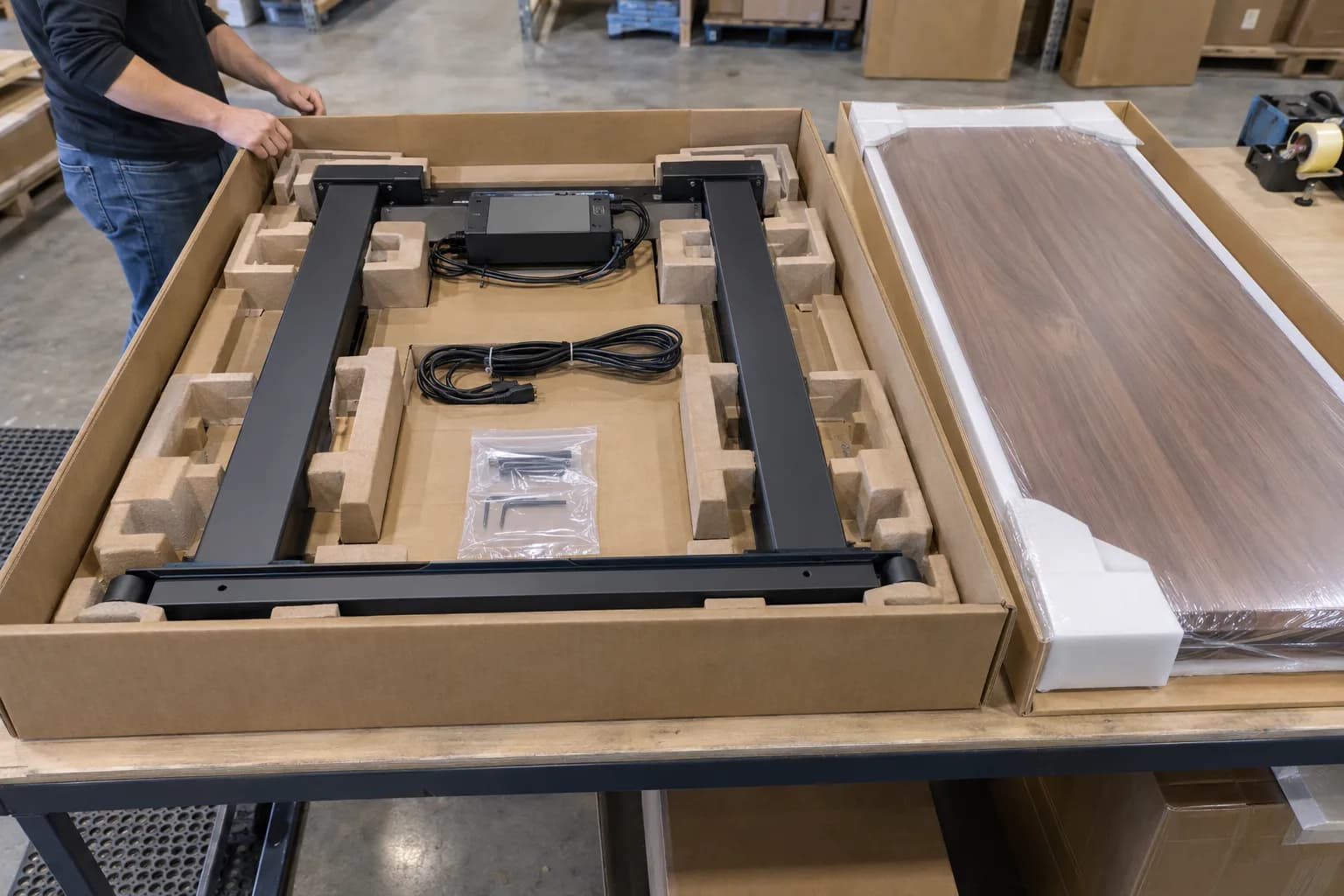
| Columns, feet and frame members | Heavy parts move, abrade finishes or concentrate load against the carton | Separation, immobilization, protected contact points and a repeatable orientation | Pack-out photo, component identity and closure reference |
| Tabletop | Faces, edges, corners, pre-drilled areas or finish can be marked during handling and stacking | Surface separation, edge/corner protection, movement control and an agreed carton relationship | Approved top/finish, pre-closure image and arrival condition |
| Motor, control box and handset | Impact, pressure, cable strain or mixing of electrical versions | Dedicated protected locations, connector protection and clear version identity | Electronics list, labels or agreed references and representative function check |
| Cables, hardware, tools and instructions | Small parts are omitted, mixed, puncture surfaces or become separated from the correct desk | Sealed/countable packs, fixed location, part list and document language/version control | Count sheet or packing list, sample carton check and exception log |
| Outer carton or palletized unit | Compression, abrasion, moisture exposure, poor handling access or ambiguous carton identity | Pack structure and unitization selected for the actual route and handling system | Carton/pallet version, markings, dimensions/weight record and selected validation report |
| Receiving handoff | Damage or shortages are found without carton, lot or photographic traceability | Defined inspection sample, isolation route and reporting time/owner | Receiving photos, carton reference, count/condition report and corrective-action link |
Design the package around the complete distribution journey
Start by mapping the route rather than choosing a carton from habit. A standing desk may move from the packing line to a factory warehouse, container or truck, port, distribution center, dealer warehouse, project site, parcel network or final installer. Those paths create different combinations of manual handling, stacking, vibration, impacts, clamp or forklift interaction, humidity and repeated transfers. The package should be designed and validated for the actual path named in the order. A successful pack for palletized project delivery does not automatically represent a parcel-to-consumer route, and a generic export-standard label does not describe the conditions tested.
Treat the frame and tabletop as different protection problems. Columns, feet and rails are comparatively heavy and can damage their own finish, puncture a carton or mark adjacent components if they are free to move. The tabletop has broad finished faces plus edges, corners and fixing areas that can be vulnerable to concentrated contact. Separate components, immobilize mass and prevent hard-to-finished-surface contact. Whether top and frame share a carton or use separate cartons is a project decision tied to weight, handling, installation sequence and distribution—not a universal quality ranking.
Give electronics a agreed location. The motor system, control box, handset, power lead and interconnecting cables should match the ordered version and remain protected from impact, crushing, sharp hardware and connector strain. Do not let a packing photograph substitute for electrical identification. The pack record should connect the physical components to the same SKU, controller/electrical version and destination information used by the order. If components can change, define how the pack layout, labels, instructions and any previous validation are reviewed before the substitution is accepted.
Small parts deserve their own system because a missing fastener can stop an otherwise undamaged installation. Use an agreed parts list, sealed or otherwise agreed packs, a repeatable carton location and clear association with the desk version. Confirm tools, brackets, fasteners, cable clips, instructions and optional accessories against the order rather than against a generic family pack. Multi-carton desks need a relationship that the receiving team can understand: carton sequence, SKU/finish identity and any order-specific marks must remain consistent without revealing or inventing regulatory conclusions.
Choose validation by purpose and route. ISTA explains that its 1 Series are integrity screening tests, 2 Series are partial-simulation tests and 3 Series provide general simulation of distribution hazards; its selection guidance lists specialized furniture separately and emphasizes familiarity with the real distribution environment. The applicable procedure depends on package type, weight, distribution channel and project requirement. Buyers should define product-damage and package-acceptance criteria before testing, retain the exact packed sample/version and request a complete report where the contract requires one. This article does not assign an ISTA procedure or claim MENBRO packaging conforms to one.
Packaging changes require review. ISTA's published guidance says retesting may be needed when the product, package or process changes, including components, materials, interior packaging or closure methods. For a standing desk, a new tabletop, altered foot, different control box, repositioned hardware pack, reduced insert, new carton dimension or changed pallet pattern can affect contact, mass distribution and handling. Record the approved pack-out as a versioned reference, then decide whether each change needs a new fit check, pack review or formal retest under the project's requirements.
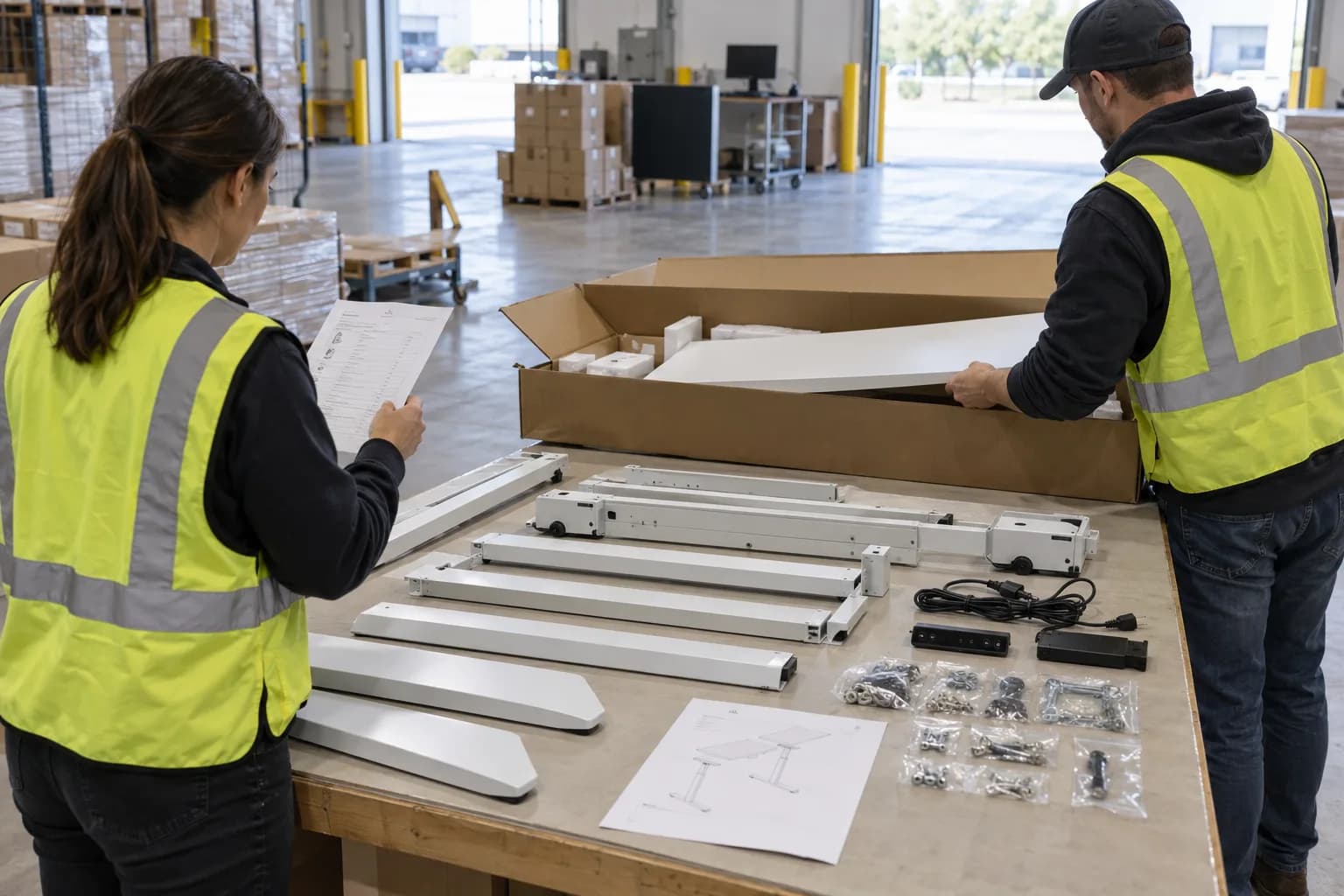
Close the loop at receiving. Define who checks carton count and identity, visible damage, wetting or deformation, component completeness, tabletop and finish condition, hardware and documents, plus any representative assembly or functional check required by the plan. Photograph exceptions before packaging is discarded and preserve carton, lot or shipment references. Separate a transport observation from a product defect until the documentation is reviewed. Arrival records are not only for claims; they show whether the selected package and validation route represent real distribution and whether the next order needs corrective action.
From product configuration to arrival feedback
Use one documented packaging loop so the product, pack, test sample and received order remain traceable to the same version.
- 1. Map the distribution routeList every planned handling, storage and delivery stage, including parcel, pallet, container, dealer, project-site and final-installation conditions where applicable.
- 2. Freeze the packed configurationIdentify frame, top, finish, electronics, cables, hardware, documents, accessories and the carton relationship for the exact order version.
- 3. Design protection and identityImmobilize mass, separate surfaces, protect edges/connectors, control small parts and define carton/SKU/version markings and multi-carton links.
- 4. Approve a pack-out referenceInspect a complete representative pack before closure and retain component, layout, carton, weight/dimension and photographic records required by the project.
- 5. Select and perform validationChoose screening or simulation work from the route, package and contractual purpose; define acceptance criteria and preserve the complete report and sample identity.
- 6. Verify production packingCheck representative cartons against the approved pack version, including contents, protection, labels, closure and any order-specific documentation.
- 7. Record arrival and improveLink shortages or damage to carton/lot documentation, investigate cause, control corrective action and review whether product, pack or process changes require revalidation.
What to Check Before You Order
Standing desk export packaging brief
- Exact desk SKU, version, finish, frame, tabletop and electronics configuration
- Distribution route, handling units, storage stages and final receiving/installation channel
- Carton count and relationship: frame, top, accessory or combined pack as applicable
- Protection and immobilization for columns, feet, rails and other heavy finished parts
- Tabletop face, edge, corner, fixing-area and finish protection
- Dedicated locations and identity for motor, control box, handset, power lead and cables
- Sealed/countable hardware, tools, brackets, instructions and ordered accessories
- Outer-carton, pallet/unitization, closure and handling design selected for the route
- Carton marks, SKU/finish/version identity, barcode and multi-carton association
- Predefined product and package acceptance criteria for any requested validation
- Approved pack-out record, representative production check and change-control owner
- Receiving count/condition check, photographs, isolation/escalation route and feedback record
Define the standing-desk pack before production
Send the selected desk, tabletop, electronics, quantity, distribution route, destination, channel and requested packaging records. MENBRO can discuss current pack options and open verification points for a project-specific inquiry.
See the MENBRO Showroom and Product Range
Watch a short introduction to MENBRO's office chairs, standing desks, lounge furniture and showroom. Ask our team for the current details of any model you are considering.
Frequently Asked Questions
What should standing desk export packaging protect?
It should protect the exact packed product through its intended distribution route: finished columns and feet, tabletop faces and edges, motor and controller parts, handset, cables, fasteners, instructions and labels. Protection, immobilization, carton identity and receiving checks should all match the approved SKU and pack version.
Should a standing desk frame and tabletop ship in one carton?
There is no universal answer. Separate or combined cartons change weight, handling, internal contact risk, labeling, installation sequence and receiving control. Decide from the actual frame, top, route and channel, then verify the selected pack-out rather than assuming one format is safer.
Which packaging test should a standing desk use?
Select a test from the real distribution environment, package type, weight and project requirement. ISTA distinguishes screening, partial-simulation, general-simulation and other procedures, and identifies specialized furniture separately. Do not assign a procedure from a generic article or claim compliance without a matching report.
What should be checked before a standing desk carton is closed?
Verify component identity and quantity, finish protection, separation and immobilization, controller and cable protection, sealed hardware, instructions, labels, carton version and any required photographs or pack-out record. The check should reference the approved order and packaging specification.
What should importers inspect when standing desk cartons arrive?
Record carton count and identity, visible condition, moisture or impact indicators if specified, component completeness, tabletop and finish condition, hardware and instructions, and a representative functional or assembly check where the plan requires it. Preserve photos and lot or carton references for any exception.
Does protective packaging guarantee damage-free delivery?
No packaging can create a blanket guarantee. Distribution hazards, handling, storage, product variation and package changes matter. Define acceptance criteria, select a relevant validation route and monitor actual arrivals so the package can be reviewed when documentation or conditions change.
References and Further Reading
These references support the product-selection and technical guidance in this article. Product availability and specifications can vary by model and project.
- ISTA test-procedure overview — Primary ISTA explanation of screening, partial-simulation, general-simulation and other test series.
- ISTA package design and test guidance — Primary guidance on route knowledge, documentation, acceptance criteria, monitoring shipments and retesting after changes.
- ISTA selecting and using procedures — Primary selection guide that identifies furniture packages and distribution-oriented procedure categories.
- Uplift packaging and shipping page — Competitor example reviewed for palletized/non-palletized packing claims; no competitor specification is used as a MENBRO requirement or capability claim.
- Dual-motor standing desk packaging guide — Competitor guide reviewed for route and pack-out topics; MENBRO adds version control, neutral test selection and receiving feedback.