

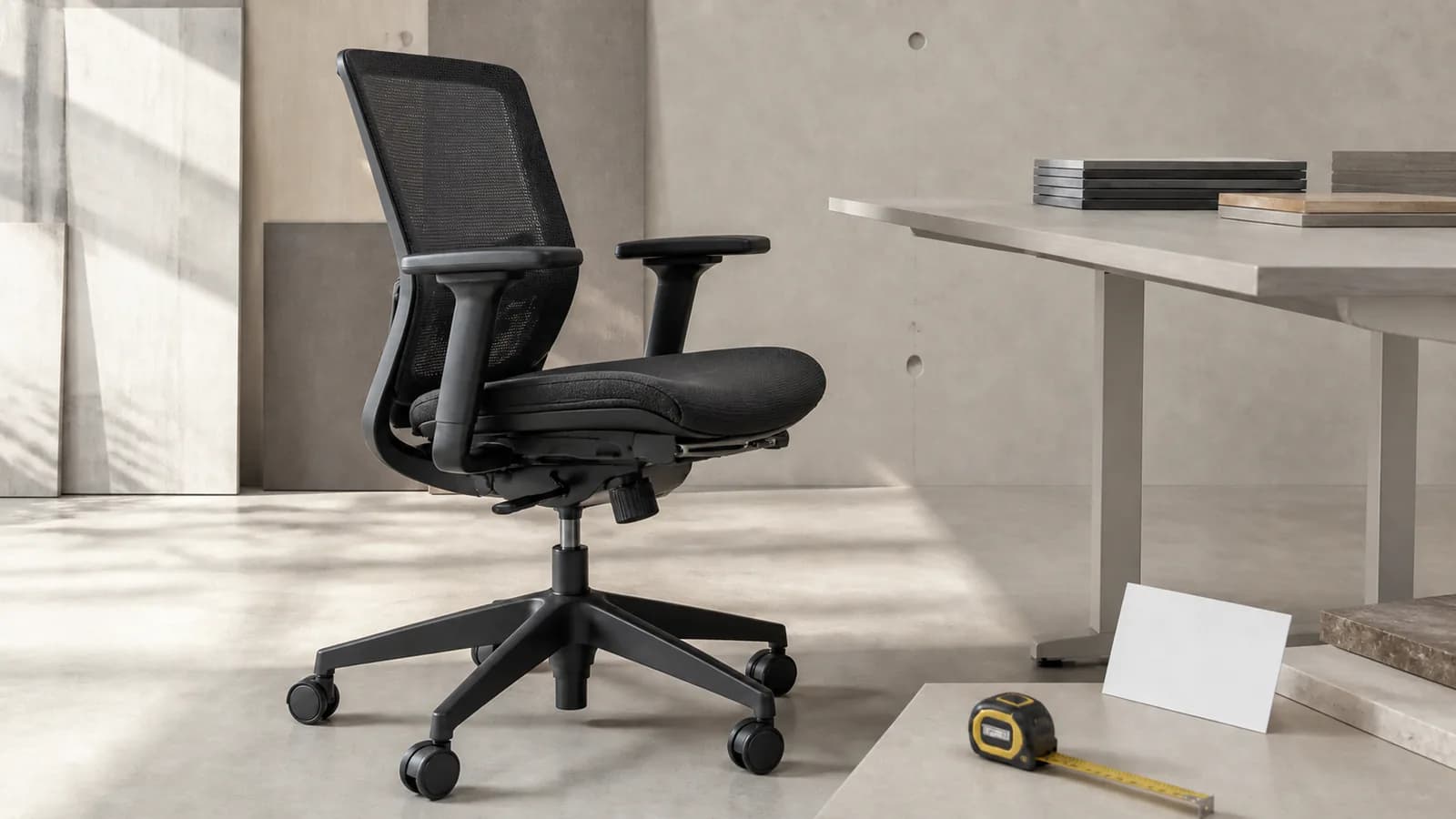
Quick answer
How should a commercial buyer specify office chair seat depth adjustment?
Specify the minimum and maximum usable seat depth, the measurement method, seat-slide travel, number and security of lock positions, control location, seat-edge profile and the intended user/workstation range. Then check representative users on the exact chair sample with their back supported and no pressure behind the knees. Do not treat a generic finger-clearance rule, a slider travel figure or a component drawing as proof that the complete chair fits the project.
Separate the seat-depth numbers before comparing chairs
Suppliers may publish similar-looking dimensions that describe different reference points. The drawing and sample should make the comparison repeatable.
| Field | What it should describe | Common ambiguity | Buyer documentation |
|---|---|---|---|
| Usable seat depth | Support distance from the effective back reference to the front edge | Uncompressed or decorative geometry may be measured instead | Dimensioned drawing with stated method and complete-chair sample |
| Adjustment range | Smallest through largest usable depth | Only the maximum depth is listed | Minimum, maximum and every stable setting |
| Slide travel | Mechanical movement of the seat pan or back relationship | Travel is presented as if it equals usable-depth range | Mechanism drawing plus measured complete-chair range |
| Lock positions | Stable selectable positions through the range | A continuous-looking slider has few or weak detents | Operate every position under representative use |
| User/workstation fit | Thigh support, knee clearance, back contact and desk relationship | Body height is used as the only fit proxy | Representative-user trial with seat height, feet and work surface set together |
A seat slider works only as part of the complete chair
Seat depth changes how much of the thigh is supported while the user remains in contact with the backrest. A seat that is too deep for a user can create pressure behind the knees or encourage the user to sit forward and lose back support. A seat that is too shallow can leave more of the thigh unsupported. OSHA and CCOHS guidance therefore connect seat depth to the user, backrest, foot support and workstation rather than treating one dimension as universally correct.
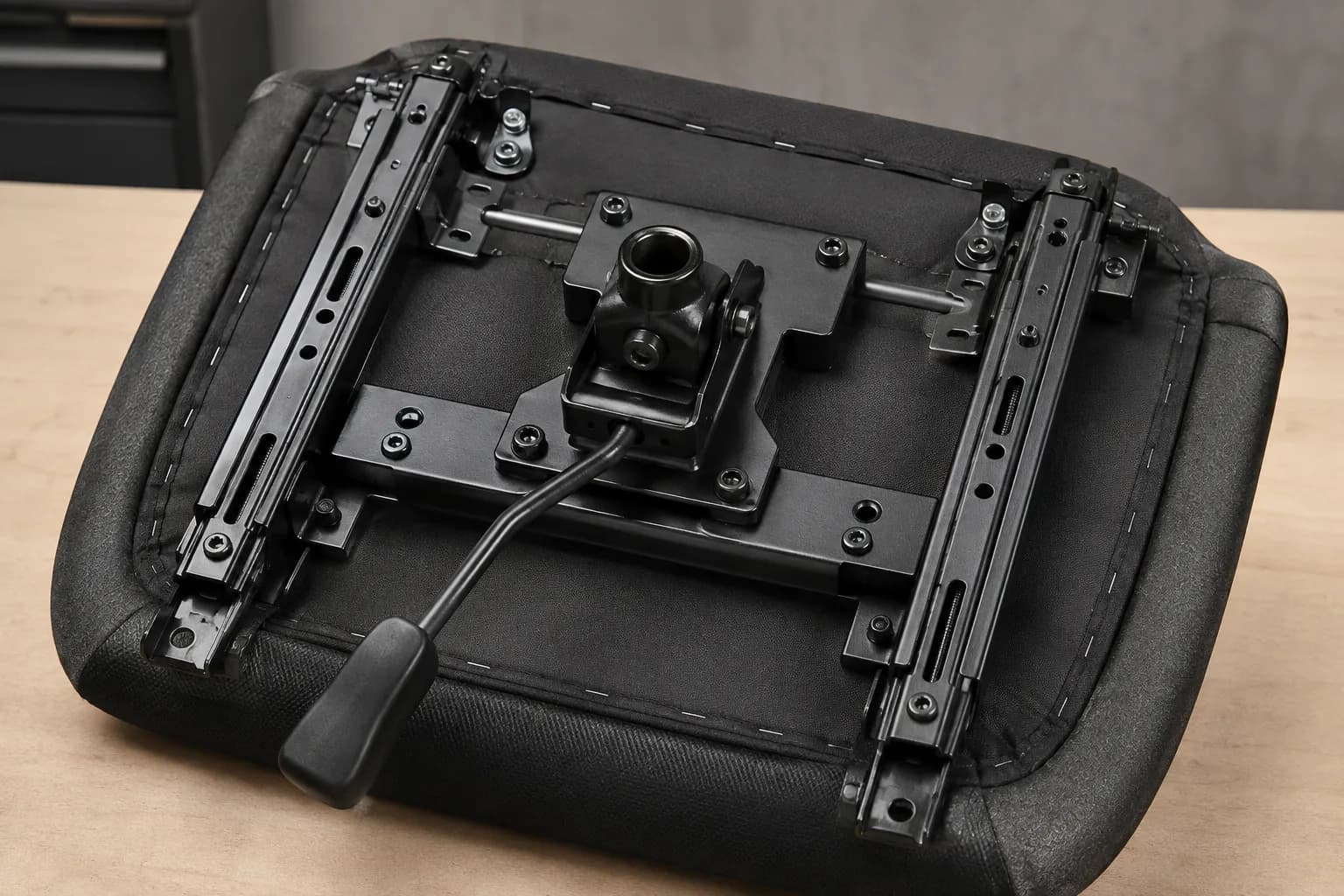
The hardware route also matters. Some chairs slide the seat pan relative to a fixed back; other designs alter the effective relationship another way. Rail length, lever access, detents, tolerances, upholstery compression and the chosen measurement reference can make the usable range different from the nominal mechanism travel. Record both values instead of assuming they are interchangeable.
MENBRO publishes chair models with different adjustment packages, and some current product descriptions identify a slidable seat. That is not a blanket promise across the range. A buyer should name the SKU, request the current dimension and component schedule, test the complete sample and attach the approved seat-slide identity to the production version.
Approve seat depth in six agreed steps
Use one repeatable sequence from user brief to production inspection. Individual medical assessment remains outside a furniture buying review.
- 1. Define the population and taskRecord shared or assigned use, task duration, workstation type, clothing or PPE considerations and any project ergonomics criteria.
- 2. Define the measurementState the reference points for usable depth, minimum and maximum positions, slide travel, seat compression condition and tolerance.
- 3. Configure the complete chairIdentify the seat, back, mechanism, gas lift, arms, base and casters together; a slider component alone cannot establish fit.
- 4. Run representative fit checksSet seat height and foot support first, then confirm back contact, thigh support, knee clearance, lever access and desk/armrest clearance.
- 5. Freeze the sampleRecord the selected setting range, hardware identity, control, fasteners, drawing version, instructions and any permitted substitution route.
- 6. Inspect productionVerify component identity and fasteners, then cycle the slider through every lock position and compare the measured range with the approved reference.
What to Check Before You Order
Seat-depth fields to add to an office-chair RFQ
- Exact chair SKU or reference design
- Intended user group, task and shared/assigned use
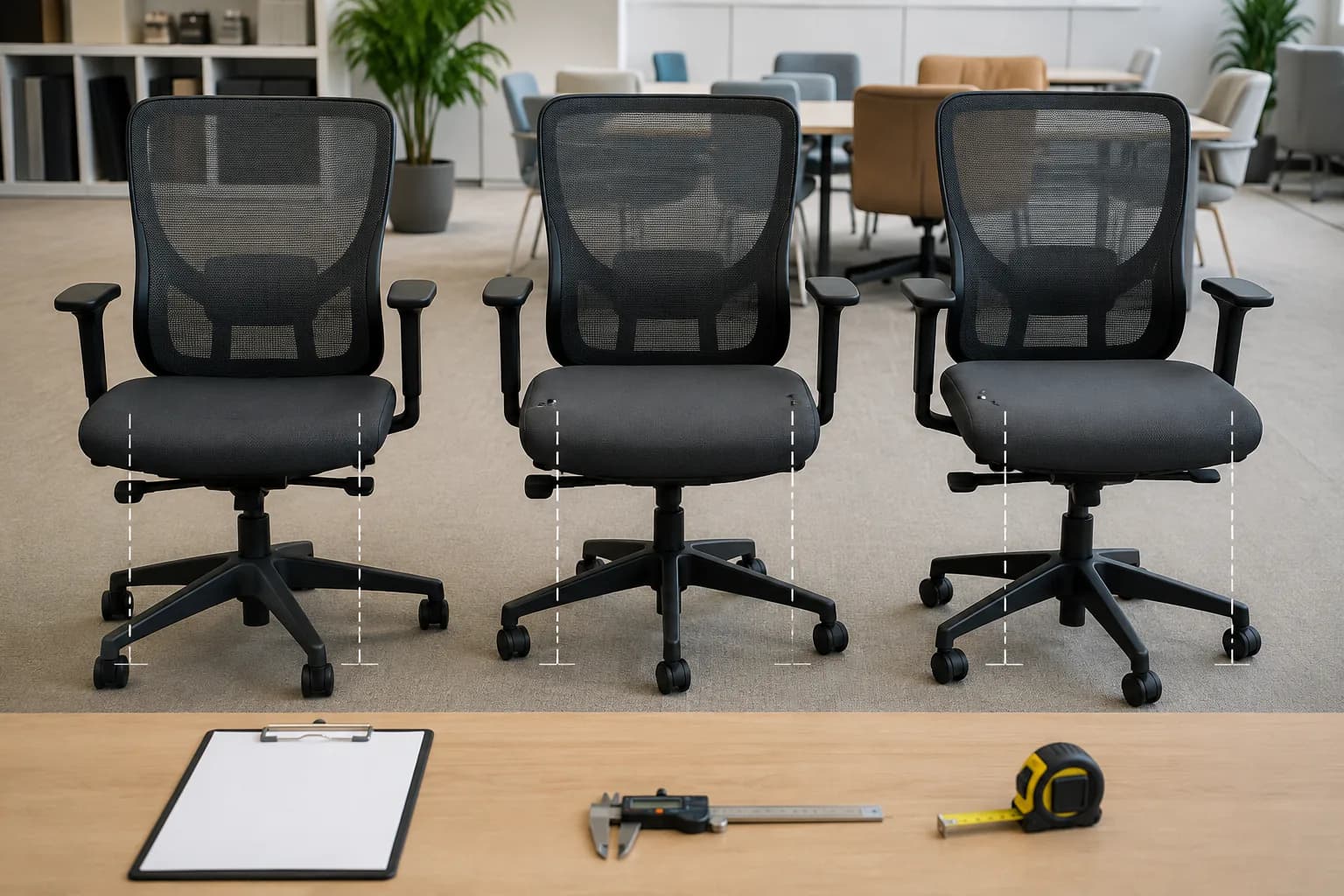
- Usable seat-depth minimum and maximum with measurement method
- Seat-slide travel, lock positions and control location
- Seat-edge profile, upholstery and compressed/uncompressed reference
- Backrest, lumbar, armrest, foot-support and desk-clearance conditions
- Representative-user sample and written acceptance method
- Component identity, tolerance, spare-part and substitution-control route
Turn a seat-slider feature into a fit-agreed chair brief
Send the chair SKU or reference, intended users and task, required usable range and controls, quantity, destination, documentation needs and target date. MENBRO will review the available model-level configuration and sample route.
See the MENBRO Showroom and Product Range
Watch a short introduction to MENBRO's office chairs, standing desks, lounge furniture and showroom. Ask our team for the current details of any model you are considering.
Frequently Asked Questions
What is office chair seat depth adjustment?
It changes the usable front-to-back support of the seat, commonly through a sliding seat pan or an adjustable back relationship. The buying specification should state the measured minimum and maximum usable depth, travel, lock positions, control method and the exact chair configuration.
How much clearance should remain behind the knees?
Guidance varies by source and user. The practical acceptance point is that the user can sit against the backrest with thigh support and without pressure from the seat edge behind the knees. Use the project ergonomics criteria and representative-user trials rather than treating one finger rule as a product guarantee.
Is seat-slide travel the same as seat-depth range?
Not necessarily. Slide travel describes mechanism movement; usable seat depth also depends on the seat contour, compressed reference points, backrest relationship and measurement method. Ask for both the travel and the measured depth range.
Does every task chair need an adjustable seat depth?
No single feature guarantees fit. A fixed-depth chair may suit a defined user group, while a shared or diverse workplace may benefit from a broader adjustable range. Evaluate the user population, task, desk geometry, foot support and the complete chair.
What should buyers test on a seat-slider sample?
Check the full travel, every lock position, unintended movement, lever access, edge pressure, back support, armrest-to-desk clearance, noise, fasteners and repeatability. Record the approved mechanism and chair version so production does not substitute a different range or control.
Can MENBRO confirm seat-depth options for a chair program?
MENBRO can review available model-level dimensions and seat-slide configurations after the buyer identifies the chair SKU, user/application brief, required range, quantity, destination and documentation needs. Availability must be confirmed for the selected configuration.
References and Further Reading
These references support the product-selection and technical guidance in this article. Product availability and specifications can vary by model and project.
- OSHA Computer Workstations — Chairs — Primary occupational guidance connecting seat-pan depth to thigh support, knee clearance, back support and a range of user sizes.
- OSHA workstation purchasing guide — Primary purchasing checklist distinguishing a sliding seat pan from other ways of changing effective depth and recommending extended user trials.
- CCOHS ergonomic chair guidance — Primary Canadian safety guidance explaining that chair fit depends on body dimensions, workstation and task, and that one chair does not fit everyone.
- ISO 24496:2021 — Official scope for office-chair dimension-determination methods; ISO states that the document does not contain dimensional specifications or requirements.
- Herman Miller anthropometrics and user control — Manufacturer research example connecting adjustable depth to buttock-popliteal length and usable control.
- MENBRO Office Chair Manufacturer — Current MENBRO chair range and model-specific specification, sample and RFQ route.