

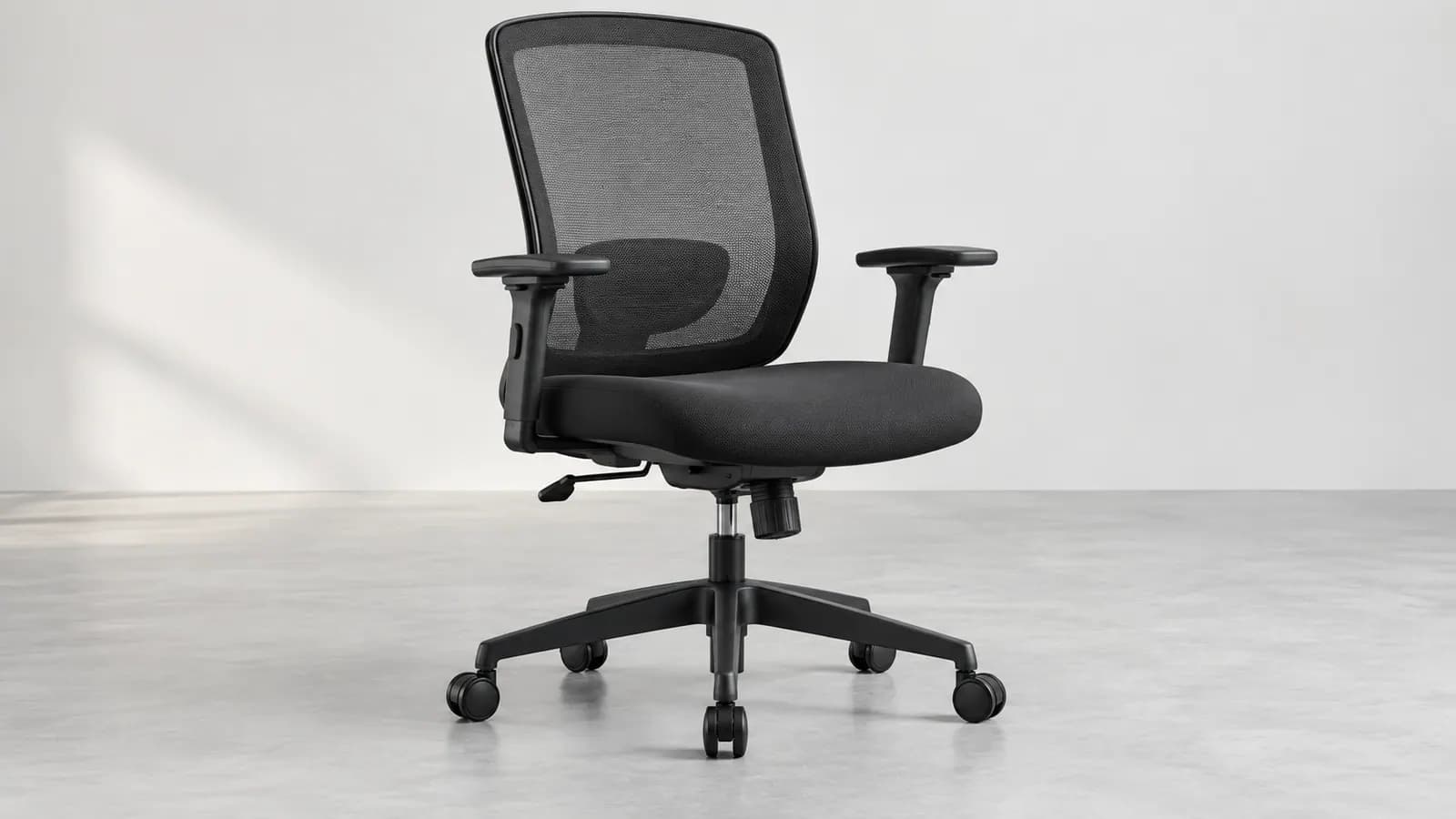
Quick answer
How should a commercial buyer specify office chair base diameter, material and stability?
Specify the base as part of the complete chair. Record spoke count, the exact diameter measurement method, material grade and construction, hub-to-gas-lift interface, caster diameter/offset, finish, ground and workstation clearance, and approved chair version. A larger diameter or a metal material name is not by itself proof of stability or durability. Review the configured chair's footprint and tilt envelope, approve a representative sample, and request documentation whose model, configuration and edition actually match the order.
Turn a base description into a agreed comparison
Material and diameter are useful fields only when their construction, interfaces and complete-chair context are visible.
| Specification field | What to record | Common shortcut to avoid | Sign-off documentation |
|---|---|---|---|
| Support footprint | Spoke count, tip-to-tip diameter and stated measurement method | Assuming a larger number alone proves stability | Dimensioned drawing plus configured-chair measurement |
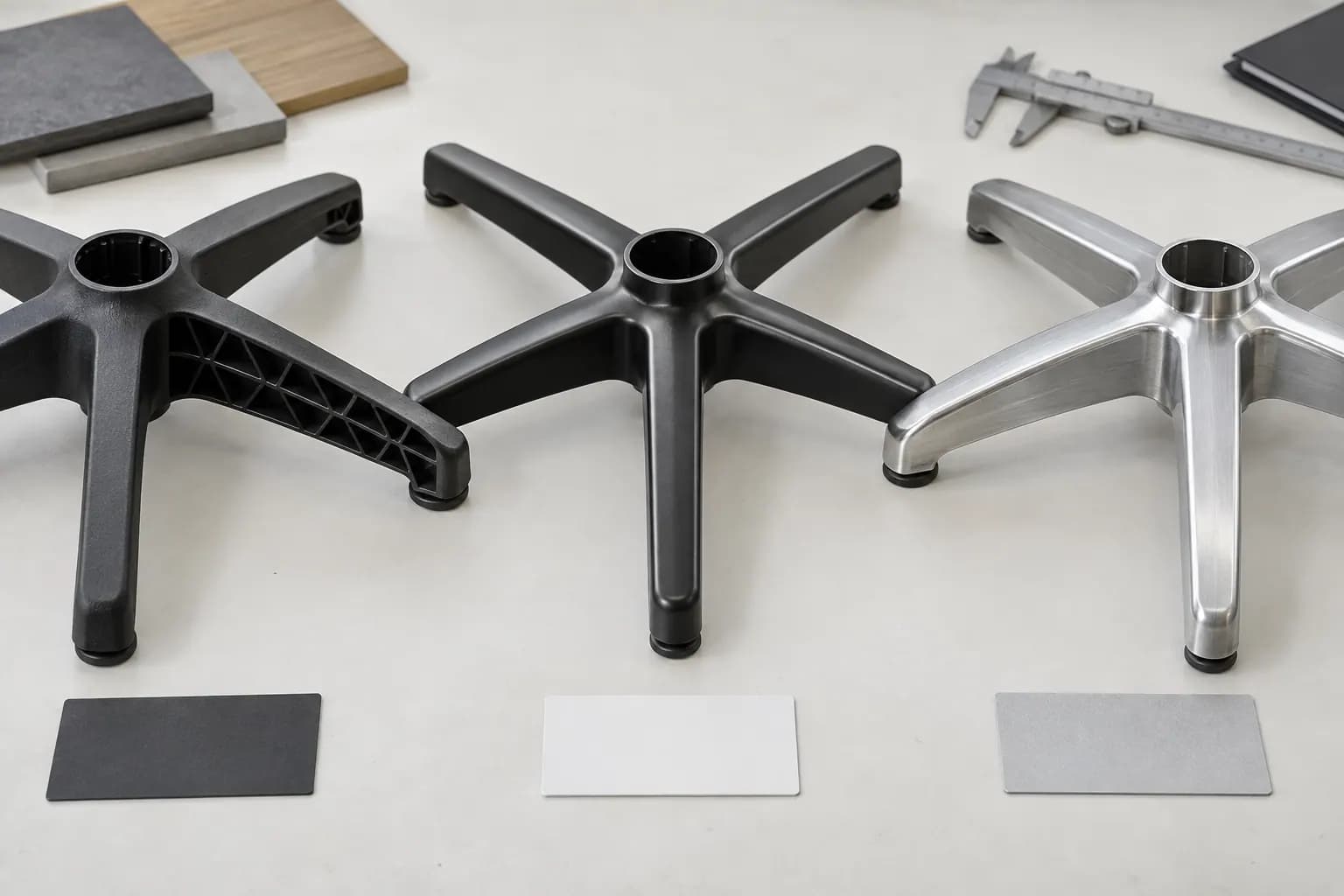
| Material and construction | Polymer grade/reinforcement, metal alloy or steel construction, section geometry and process | Ranking nylon, steel or aluminum by name only | Agreed part specification, supplier identity and sample |
| Hub interface | Bore/taper, seating depth, tolerance and matched gas-lift identity | Treating a visually similar base as interchangeable | Fit check and released base/lift/BOM version |
| Caster geometry | Socket/stem, wheel diameter, offset, quantity and floor option | Changing wheel or caster without rechecking geometry | Complete base assembly and floor-specific caster schedule |
| Complete-chair behavior | Seat/back geometry, tilt, height, load requirement and intended use | Using a component rating as a chair stability claim | Applicable complete-chair report or project acceptance record |
Base material is not a performance hierarchy
CCOHS recommends a stable five-point base, while commercial manufacturers publish chair-specific base materials and dimensions. Herman Miller, for example, lists die-cast aluminum and glass-reinforced nylon variants within one chair family, and Steelcase publishes a five-star base diameter for a specific QiVi configuration. These examples show why a buyer needs the exact model and construction; they do not create a universal ranking among materials or a transferable dimension.
A polymer base can use reinforcement, ribbing and section geometry, while a metal base can vary by alloy, casting, fabrication, wall thickness, weld quality and finish. Surface appearance does not identify those properties. The hub is equally important: the gas lift must seat to the agreed interface and tolerance. A different base or lift can alter installed height, alignment, clearance and the approved chair configuration even when both parts look compatible.
Stability belongs to the assembled chair. The support footprint interacts with the seat, back, tilt mechanism, user position, lift height, caster offset and floor contact. BIFMA describes office-chair standards as complete-product safety and durability evaluations. Therefore, a base dimension, material certificate or isolated component load value must not be presented as a complete-chair result; documentation needs the correct chair model, configuration, standard edition and report coverage.
Approve an office chair base in seven agreed steps
Start from the complete chair and intended use, then freeze the base, lift and caster assembly together.
- 1. Identify the chair and useRecord SKU/version, chair type, user/application brief, floor system, tilt functions, destination and required documentation.
- 2. Define the measurementState spoke count and how base diameter or footprint is measured so drawings, samples and inspections use the same reference.
- 3. Specify constructionName material grade or reinforcement, section/rib geometry, manufacturing process, finish and agreed supplier/part identity.
- 4. Lock the interfacesConnect base hub, gas lift, caster socket/stem, wheel diameter and installed seating depth to one BOM version.
- 5. Review complete-chair geometryCheck seat-height range, ground and foot clearance, desk relationship, caster sweep, tilt envelope and assembled footprint.
- 6. Approve sample and documentationInspect fit and finish on the representative chair and confirm that any requested test document matches its model, configuration and edition.
- 7. Control production and changesInspect base identity and dimensions, preserve lot/version traceability and require written review before any base, lift or caster substitution.

What to Check Before You Order
Office chair base fields to add to an RFQ
- Chair SKU, version, intended use and destination
- Spoke count and base-diameter/footprint measurement method
- Material grade, reinforcement, construction/process and finish
- Hub bore/taper, seating depth, tolerance and matched gas-lift identity
- Caster socket/stem, wheel diameter, offset and floor schedule
- Installed seat-height, ground, foot and workstation clearance checks
- Applicable complete-chair stability/durability documentation and report coverage
- Approved sample, incoming/final inspection, spares and substitution-control route
Turn a five-star base option into a complete-chair specification
Send the chair SKU or reference, intended use, base/finish preference, floor and caster schedule, quantity, destination, required documentation and target date. MENBRO will review the model-specific base and complete-chair route.
See the MENBRO Showroom and Product Range
Watch a short introduction to MENBRO's office chairs, standing desks, lounge furniture and showroom. Ask our team for the current details of any model you are considering.
Frequently Asked Questions
What office chair base diameter should a commercial buyer specify?
There is no universal diameter that is correct for every chair. Record the measurement method, complete-chair footprint, seat and back geometry, tilt behavior, caster diameter, clearance and intended use, then approve the configured chair against the applicable stability and durability requirements.
Is a larger office chair base always more stable?
Not automatically. A wider support footprint can affect the stability envelope, but the chair's center of mass, seat/back geometry, recline, user loading, gas lift, caster position and complete assembly also matter. Base diameter alone is not a stability result.
Is an aluminum office chair base stronger than a nylon base?
Material family alone does not prove strength or durability. Alloy or polymer grade, reinforcement, section geometry, wall thickness, hub design, manufacturing process and complete-chair testing all affect performance. Compare the agreed construction and applicable documentation, not only the finish name.
Why must the base hub and gas lift be approved together?
The hub bore, taper/interface, seating depth and manufacturing tolerances determine how the gas lift locates in the base. A visually similar replacement can change fit, height, alignment or retention, so the approved base, lift and chair version should remain linked.
Can changing casters affect the office chair base specification?
Yes. Caster diameter, stem/socket fit, offset and rolling behavior can change seat height, ground clearance, footprint and use on the intended floor. Recheck the complete chair whenever the base or caster configuration changes.
What base information should an office-chair order retain?
Retain the chair SKU and version, base supplier/part, spoke count, diameter measurement method, material and construction, hub interface, caster configuration, finish, approved sample, applicable complete-chair documentation, inspection points, spares and substitution route.
References and Further Reading
These references support the product-selection and technical guidance in this article. Product availability and specifications can vary by model and project.
- CCOHS ergonomic-chair guidance — Primary Canadian occupational-safety guidance recommending a stable five-point base; it does not prescribe one universal diameter or material.
- BIFMA standards descriptions — Primary office-furniture standards context explaining that chair standards evaluate complete-product safety, durability and structural adequacy.
- Steelcase QiVi specifications — Manufacturer example tying a five-star base material, diameter, caster and chair configuration to one named product family.
- Herman Miller Aeron materials — Manufacturer example of die-cast aluminum and glass-reinforced nylon base constructions within controlled product variants.
- Herman Miller Aeron dimensions — Manufacturer model/size example showing why overall dimensions and configuration must remain chair-specific.
- UNICOR office seating specification — Government manufacturer specification showing model-level base, caster, finish and order-code combinations rather than a universal component rule.
- MENBRO Office Chair Manufacturer — Current MENBRO chair range, model-specific base/caster/sample discussion and RFQ route.