


Quick answer
Should an office reception use lounge chairs or a sofa?
Use separate lounge chairs when independent visitors need clearly defined places and the room supports that arrangement. Consider a sofa for people waiting together or a shared conversational setting. Test a mix when both patterns occur. Compare usable seats, approach, table relationships, care interruption and replacement on the actual proposed products. Neither a nominal seat count nor a furniture photograph establishes the right reception capacity or layout.
Compare lounge chairs and reception sofas by use
These are planning questions, not a product ranking. Return to the actual chair, sofa and room plan before choosing; the same furniture format can work differently in another reception.
- Independent visitor choice
- Position each piece deliberately
- Review one-item withdrawal
- Companion-group waiting
- Check actual usable places
- Confirm whole-item care access
- Offer different ways to wait
- Coordinate tables and approach
- Avoid counting every gap as a seat
| Decision | Separate lounge chairs | Sofa | Check on the proposal |
|---|---|---|---|
| Independent arrivals | Each place is visibly its own item | Unrelated visitors share one seating object | Whether the available places are actually likely to be used |
| People arriving together | A group occupies several individual pieces | Companions can share a setting | How pairs or small groups wait without displacing other visitors |
| Conversation | Orientation can be considered per chair | Shared facing direction depends on the sofa form | Reception contact, sightlines and a suitable alternative for private discussion |
| Tables and belongings | Several positions may need useful surfaces | One table may not serve every sofa place equally | Reach, bags, drinks and approach in the actual occupied arrangement |
| Room fit | More separate outlines to coordinate | One larger object still needs usable approach | The full layout rather than an outline-only seat calculation |
| Care interruption | One item may be taken out separately | Service access depends on the selected construction | What is removable or serviceable and where care takes place |
| Replacement | A single-piece replacement may be a useful route | Replacing one component or the whole item depends on the model | Confirmed supply, finish and service options rather than assumptions |
| Mixed layout | Can define individual visitor positions | Can anchor a companion setting | A written reason for each piece and an agreed room plan |
Start with arrivals, then compare the furniture
A reception is a working arrival point as well as a visual introduction to the office. Visitors may arrive alone, with colleagues or with a host who joins them briefly. The right chair-versus-sofa decision should explain those situations in ordinary terms. An attractive set of matching objects is only the start of the review.
Describe who waits and what happens while they wait
Ask the reception team for a practical description of normal arrivals and busy periods. Distinguish an individual visitor waiting for a meeting, two colleagues arriving together and someone completing a short check-in task. Record the activities that furniture must support: sitting briefly, discussing a document, placing a bag or speaking with a host. Do not invent visitor numbers or waiting times to make a particular layout look justified.
Give each scenario its own question. Can an independent arrival choose a clear place without negotiating a shared cushion? Can companions wait together without occupying every separate chair? Can a host make contact without moving furniture into the approach? These questions produce a more useful brief than simply requesting a sofa with the largest advertised number of seats.
Keep operational needs separate from brand appearance. A quiet professional reception and a more social project studio may choose different combinations, but neither setting is defined by upholstery color alone. Agree which visitor situations matter most, then use that short list to compare proposals. It also gives the buyer a reason to accept or reject an alternative offered later.
Count usable places rather than cushion labels
A catalog seat count describes the product in its stated context; it does not tell you how unrelated visitors will distribute themselves across it. Cushion divisions, arms, personal belongings and the relationship between people can affect which places they choose. Review likely use with the actual sample and avoid treating an unoccupied section of upholstery as proof that the reception has spare capacity.
Separate chairs make each place explicit, but they still need to work in the room. A chair tucked behind a table, facing away from reception contact or difficult to approach may be less useful than its symbol suggests. Conversely, a sofa can be a sensible shared place for a pair arriving together. The decision is about usable arrangements, not declaring one format efficient in every building.
Haworth's reception inspiration document and Steelcase's workplace settings provide examples of furniture relationships rather than a universal seat formula. NaughtOne's Mimo family shows that chair and sofa formats can exist within one design language. Use those sources to ask better selection questions; their product characteristics and layouts do not establish the capacity or performance of a MENBRO proposal.
Review conversation and personal space without promising privacy
Consider the direction visitors face, their relationship to the reception desk and whether a host can join them naturally. Separate chairs may allow an intentional arrangement around a table, while a sofa creates a shared seating line or corner according to its form. Neither automatically creates a good conversation setting. Review the actual positions rather than assuming that a higher back or a curved outline solves the interaction.
An independent seat can offer a clearer personal place without making confidential speech private. Reception is often crossed by staff, deliveries and other visitors. If a conversation involves sensitive information, the operating plan should identify a suitable alternative location. Do not describe a particular seat separation, upholstery or backrest as acoustic protection without appropriate project-specific documentation.
Compare the occupied setting, including tables and belongings
Place the proposed coffee and side tables on the same plan as the seating. Ask whether each intended place has a useful relationship to a surface for the activities in the brief. A large central table may look balanced in a rendering but be awkward for an end seat. A side table may work for one chair while narrowing another person's approach. Review use from each position, not just the view from the entrance.
Include bags, coats and the ordinary movement of people joining or leaving a group. Furniture should not depend on belongings being left in a route or on reception staff repeatedly shifting chairs. Ask the responsible designer to coordinate access, circulation and applicable local requirements. The US Access Board route guide is one jurisdiction's primary reference; it is not a global room-sizing rule or a MENBRO product certification.
This is a format-selection exercise rather than the later numerical reception-dimensions guide. Use actual product and site drawings for measurements and have unresolved requirements reviewed by the project team. Do not add another chair merely because a gap remains on the plan. A gap can have a purpose even when it contains no furniture.
Ask what happens when one piece needs attention
Compare access for ordinary cleaning with the selected upholstery and construction. Can staff reach around the item in its intended location? What instructions apply to the actual surface? If a cushion, cover or other part is described as replaceable, ask what the service route includes. Do not infer removability from a visible seam or assume that any cleaning product used elsewhere in the office is suitable.
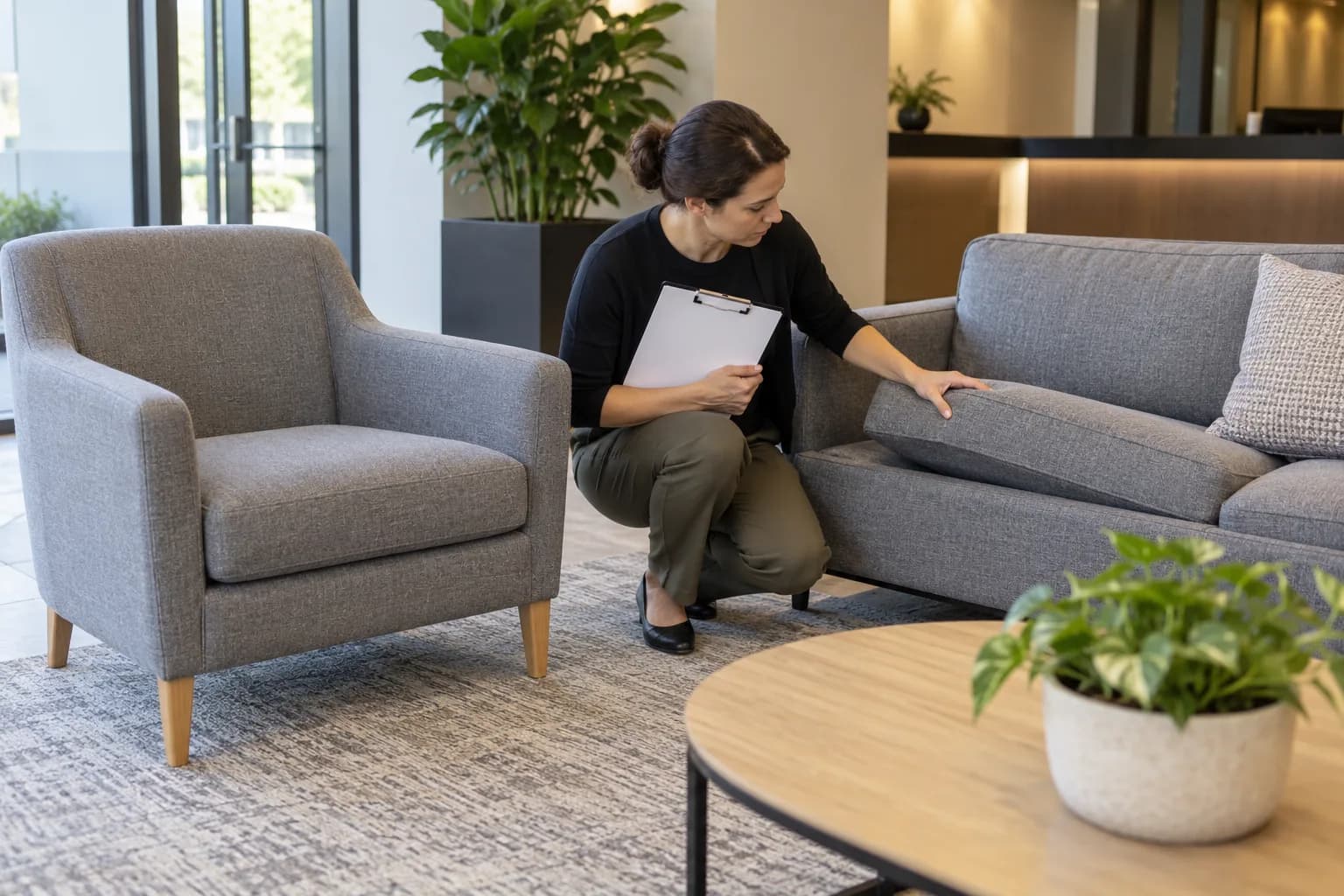
Consider the operational interruption. With separate chairs, it may be possible to withdraw an individual item while the remaining setting continues to work. A sofa might have a supported component-service route, or it might need to leave as a complete object. Ask the supplier to confirm the actual options. Neither format justifies an invented maintenance interval, durability claim or warranty promise.
Steelcase's cleaning resources distinguish the manufacturer's products and material instructions. They are useful as an example of the information to request, not as a recipe for MENBRO upholstery. The existing contract-lounge upholstery guide handles material and performance specifications; keep this comparison focused on access, responsibility and the consequences of a care or replacement decision.

Turn visitor scenarios into a reception seating choice
Keep the decision record short enough for the buyer, designer and facilities team to share. A later alternative should be compared against the same requirements rather than accepted on appearance alone.
- 1. Write the use briefList typical arrival groups, activities, contact with reception and the care team's needs. Distinguish observed use from an untested expectation. Identify which requirements are essential and which are preferences so a supplier can propose an alternative without silently changing the purpose of the setting.
- 2. Build chair, sofa and mixed optionsUse current named products and the same visitor scenarios for each option. Record why each piece is included. Compare likely usable places rather than nominal seats alone, and keep unanswered model details visible. A mixed layout should solve two defined needs instead of adding variety for its own sake.
- 3. Coordinate the roomHave the designer place actual seating, tables, fixed elements and required approach areas together. Review the occupied positions and belongings as well as the furniture outline. Route and site requirements remain the responsibility of the appropriate project professionals; this comparison does not replace their assessment.
- 4. Review representative productsTry the proposed chair and sofa in the relevant use scenarios, with appropriate table relationships. Check individual and companion positions, contact with the host and the practical handling questions. Record what the sample does not represent, such as an alternative material or a different sofa size, before accepting it as the order reference.
- 5. Confirm care and replacementObtain the applicable product and material instructions, confirmed serviceable components and enquiry route. Ask what happens when an item is unavailable for use. Retain current product references and finish samples without promising that an identical replacement will remain available indefinitely or match a later production batch exactly.
- 6. Record and release the choiceKeep the accepted layout, product identities, material references, sample decision and unresolved items with the quotation. State who must review a later substitution. The resulting choice may be chairs, a sofa or a mix; its value is that the reception team can explain how it serves the intended visitors and how it will be supported.
What to Check Before You Order
Reception chair-versus-sofa confirmation checklist
- Independent arrivals and companion groups described
- Waiting activities and host contact identified
- Current chair and sofa references attached
- Usable-place assumptions separated from catalog capacity
- Occupied positions and table relationships reviewed
- Belongings and normal approach included in the room review
- Access and circulation referred to the responsible designer
- Private conversations assigned an appropriate location
- Product/material cleaning instructions requested
- Serviceable parts and withdrawal consequences confirmed
- Representative sample and unresolved differences recorded
- Accepted layout, finishes and substitution owner retained
Compare a reception proposal against your visitor brief
Send the room plan, visitor scenarios, chair or sofa references, material preferences and destination. MENBRO can discuss current models, configuration questions and the sample information needed for a project-specific decision.
See the MENBRO Showroom and Product Range
Watch a short introduction to MENBRO's office chairs, standing desks, lounge furniture and showroom. Ask our team for the current details of any model you are considering.
Frequently Asked Questions
Are lounge chairs or sofas better for an office reception?
Choose from the actual visitor pattern. Separate chairs can give independent arrivals a clearly defined seat and allow individual pieces to be positioned or removed where the plan permits. A sofa can suit people waiting together and create a shared setting. A mixed arrangement may serve both, but it needs a coordinated room, table and care plan rather than an arbitrary furniture count.
Does a three-seat sofa always provide three usable waiting seats?
No. The product's nominal capacity does not describe every visitor scenario. Consider cushion layout, arms, personal belongings, who arrives together and how unfamiliar people choose places. Review the actual proposed sofa and expected use. Do not turn a catalog seat label into a guaranteed reception capacity or compensate by crowding additional chairs into circulation space.
Do separate lounge chairs provide privacy?
A separate chair defines an individual place but does not guarantee visual or acoustic privacy. Position, orientation, neighboring visitors, reception-desk activity and room design all matter. If confidential discussion is needed, establish an appropriate alternative location and operating procedure. A high back or a gap between seats is not proof that speech cannot be overheard.
Is a sofa always more space-efficient than lounge chairs?
Not automatically. Compare the full proposed arrangement, including arms, tables, chair approach, belongings and access, rather than furniture outlines alone. A sofa may combine places within one object while a particular chair layout may better suit the room. Ask the designer to check the actual plan and applicable site requirements; there is no universal footprint-to-seat rule in this guide.
Which option is easier to clean and maintain?
It depends on the selected product's construction, upholstery instructions, access and service arrangements. A separate chair may allow one item to be withdrawn while others remain; a sofa may have its own serviceable components or require treatment as a whole. Confirm what can actually be cleaned, removed or replaced and what interruption that creates. Do not infer removable covers or chemical compatibility from appearance.
Should reception seating use one matching furniture family?
A matching family can help coordinate appearance, but it does not establish that every chair, sofa and table works together in use. Review actual seat positions, table reach, arms, finishes and maintenance information. A considered mix can also work. Keep the final product identities and samples together so visual consistency does not conceal different care or replacement requirements.
What should I send MENBRO for a reception seating enquiry?
Provide the reception plan, typical visitor groups and activities, proposed chair/sofa references, quantity, destination, preferred material and care requirements. Identify what is fixed and what can change. Ask for current model information, sample options, available documents and a written configuration proposal. This guide does not assign a price, delivery term, warranty or tested performance to an unspecified model.
References and Further Reading
These references support the product-selection and technical guidance in this article. Product availability and specifications can vary by model and project.
- Haworth Reception Inspiration Layouts 2025 — Manufacturer reception-setting examples; no dimensions, prices or arrangements reproduced.
- Steelcase Resilient Workplace — Context for varied workplace settings, not a reception capacity or business-outcome claim.
- NaughtOne Mimo — Named chair/sofa/modular family example; its product characteristics are not MENBRO claims.
- Steelcase product cleaning guidance — Example of manufacturer/material care boundaries; cleaning recipes and medical claims are not adopted.
- US Access Board accessible-route guide — United States route context; project applicability needs qualified local review.