

Quick answer
Should an office project use task, executive or conference chairs?
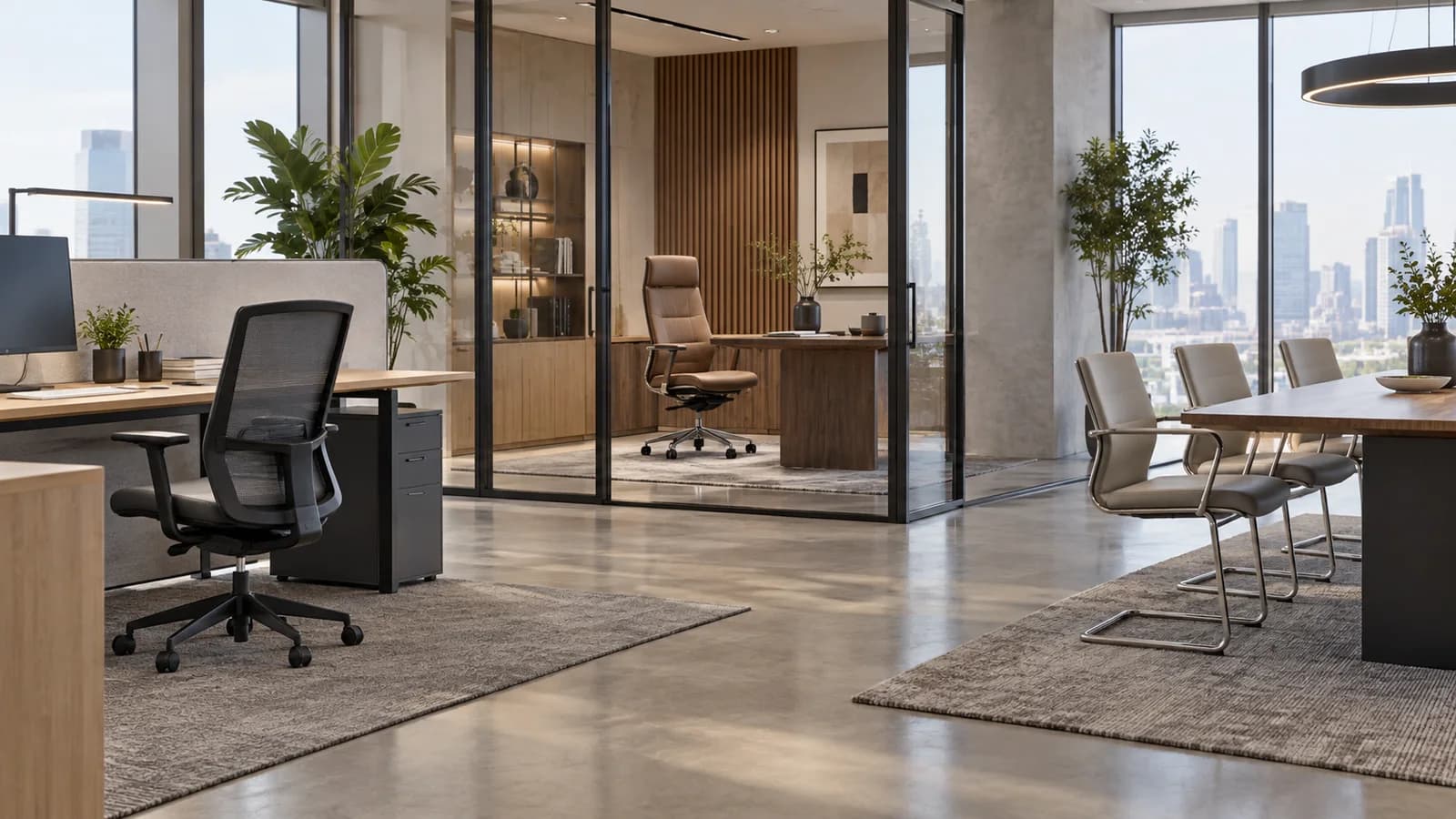
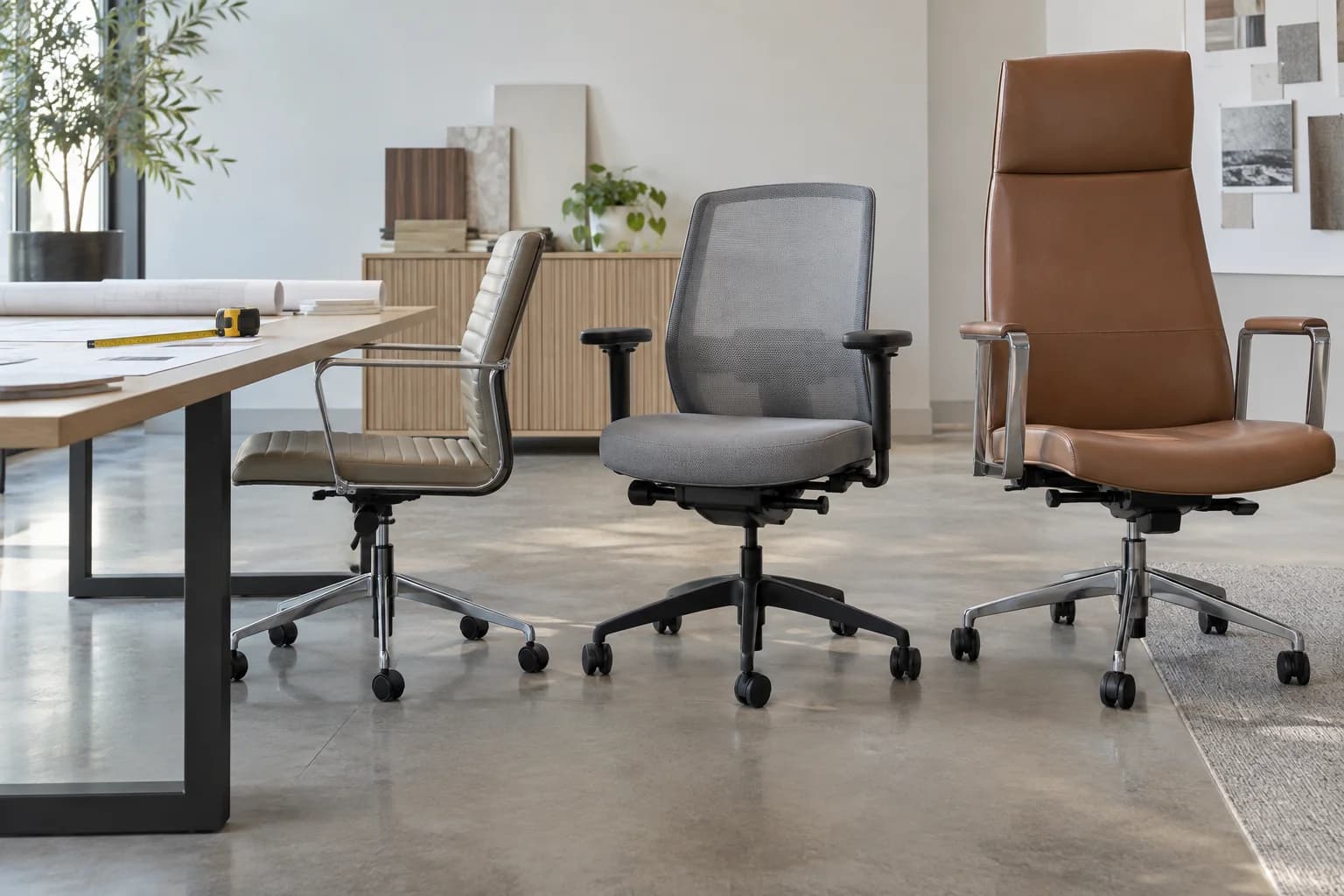
Choose by work pattern and room—not status. Task chairs usually suit individual desk work and repeat adjustment; executive chairs often combine desk use with a stronger private-office presence; conference chairs prioritize shared use, table clearance, movement and a consistent room layout. These labels overlap, so approve the exact SKU, dimensions, options and sample for each zone.
Task, executive and conference chairs: a project comparison
The rows describe common project roles, not guaranteed features. A model can cross categories, and two chairs with the same label can have very different dimensions and controls.
- Assigned or shared seat
- User-size range
- Adjustment learning and access
- Focused desk work
- Private-office work and visitors
- Meetings, presentations and turnover
- Desk and equipment
- Room scale and finish brief
- Table, capacity and circulation
| Chair role | Typical project job | Compare on the actual model | Common specification mistake |
|---|---|---|---|
| Task chair | Individual or shared workstation use with repeated desk interaction | Seat and back fit, usable adjustment range, arm/desk clearance, movement, controls, materials and service parts | Assuming every task chair is either short-use or automatically ergonomic |
| Executive chair | Private office, leadership workstation or a room that needs a larger visual presence | User and desk fit, back and seat geometry, adjustment package, upholstery/finish, visitor interaction and room scale | Treating premium appearance as proof of fit, performance or all-day suitability |
| Conference chair | Shared seating around meeting, boardroom or collaborative tables | Chair width and depth, arm/table clearance, base and movement, entry/exit, cleanability, stacking/nesting where applicable and room capacity | Choosing from appearance alone before checking the table and circulation |
| Cross-category model | One chair family used in more than one zone | Which base, arms, height, controls and finish change by room; consistent parts and visual language | Using the same name while ordering different configurations without a schedule |
Category names do not replace a room schedule
The terms task, executive and conference describe common market positions, but they are not universal performance grades. BIFMA's published definitions place executive/management, task/secretarial and several other styles inside the broader general-purpose office-chair category. That is useful context: a category label does not tell a buyer which test report, adjustment range, dimension or finish applies to the selected chair.
For task seating, begin with the work and the user population. An assigned workstation may need one person's repeatable setup; a shared desk may need controls that different users can find and reset. OSHA and CCOHS both emphasize chair-to-user and chair-to-workstation fit, including seat/back support, adjustment, arm position and work-surface interaction. Translate those principles into model-level dimensions, controls and a user trial rather than promising one chair fits everyone.
An executive chair should earn its place through the private-office brief, not hierarchy alone. The occupant may alternate between focused screen work, reading, calls and face-to-face meetings. Compare the exact chair's seat and back geometry, controls, materials, desk clearance and visual scale. A high back or upholstered finish can support the desired room language, but neither proves comfort, durability or conformity without the relevant model information.
Conference seating starts with the table and room. Record the number of seats, chair footprint, arm and seat height, table-edge or apron clearance, pull-back space, circulation, floor surface and how often users enter and leave. A slim four-leg chair, a swivel chair and a fully adjustable task chair can each work in a meeting room under different conditions. The label conference does not settle capacity or movement.
Finish with operations. Ask whether casters or glides suit the floor, whether controls can withstand shared use, how upholstery will be cleaned, and which parts can be serviced. Then assign every room an exact SKU and version. This project-level schedule is intentionally different from MENBRO's distributor assortment guide, which helps a seller decide what range to stock across customers rather than what one project should install in each zone.

Turn room uses into a chair schedule
A room-by-room sequence keeps aesthetic decisions connected to fit, operations and an orderable configuration.
- 1. Map the zonesList workstations, private offices, meeting rooms, touchdown spaces and any other seating location with planned quantities.
- 2. Describe the useRecord assigned or shared use, tasks, likely sitting pattern, user range, visitors, equipment and expected room turnover.
- 3. Define fit constraintsCheck desk or table geometry, arm clearance, chair footprint, pull-back space, circulation, floor surface and storage needs.
- 4. Shortlist exact modelsCompare dimensions, adjustments, base, arms, materials, cleaning, service route and the documentation required for each configuration.
- 5. Mock up representative roomsPlace sample chairs with the actual or representative desk/table and involve intended users; record outliers and unresolved conflicts.
- 6. Release the scheduleAssign zone, quantity, SKU, finish, option package, approved sample and file version so buying and installation receive one clear brief.
What to Check Before You Order
Room-by-room chair selection brief
- Room or zone name, quantity and assigned/shared use
- Primary tasks, equipment, visitors and expected turnover
- Intended user range and any identified accommodation route
- Desk/table height, edge or apron, knee space and chair clearance
- Chair footprint, base, casters or glides and floor condition
- Seat, back, arms, lumbar, tilt and other required model controls
- Material, finish, cleanability and visual relationship to the room
- Assembly, maintenance, compatible parts and service information
- Exact SKU/configuration and model-specific documentation requirement
- Approved sample, room mock-up result and current schedule version
Build one chair brief for every project zone
Send the room schedule, chair quantities, table or desk constraints, user and adjustment needs, finishes and destination. MENBRO can confirm current model options for a project-specific review.
See the MENBRO Showroom and Product Range
Watch a short introduction to MENBRO's office chairs, standing desks, lounge furniture and showroom. Ask our team for the current details of any model you are considering.
Frequently Asked Questions
What is the main difference between task, executive and conference chairs?
The useful difference is the job each chair must perform. Task chairs commonly serve individual desk work and repeated adjustment; executive chairs often combine desk use with a larger visual presence in private offices; conference chairs prioritize shared use, table fit and meeting-room movement. The labels overlap, so compare the exact model.
Is an executive chair automatically better than a task chair?
No. Executive is a style or application label, not a universal performance grade. A task chair may offer a better adjustment range for workstation use, while an executive chair may better suit a private-office brief. Review the selected SKU, documentation and user trial.
Can a task chair be used in a conference room?
Yes, if its size, arms, base, casters, controls and appearance work with the table, room capacity and meeting pattern. Some task chairs are too large or visually busy for a dense conference layout; others can provide useful shared-seat adjustment.
What should be checked when a conference chair meets the table?
Check chair width and depth, arm and seat height, table-edge and apron clearance, base footprint, caster or glide behavior, pull-back space, circulation and the selected quantity around the actual table layout.
Should every private office use an executive chair?
Not necessarily. Match the occupant's work, visitors, desk geometry, adjustment needs and visual brief. A task chair can be appropriate in a private office, while an executive-format chair still needs to fit the user and workstation.
How should chair types be recorded in a project schedule?
Use room or zone, quantity, exact SKU/configuration, finish, arms, base, casters or glides, adjustment package, approved sample and related document version. Do not release an order using only task, executive or conference as the product description.
References and Further Reading
These references support the product-selection and technical guidance in this article. Product availability and specifications can vary by model and project.
- BIFMA PD-1 furniture definitions — Primary industry definitions showing several named seating styles within general-purpose office chairs.
- OSHA computer-workstation chair guidance — Primary US workplace guidance on fitting chairs to users and workstations; it does not endorse a MENBRO model.
- CCOHS work-chair selection — Primary Canadian occupational-safety guidance on selecting adjustable seating appropriate to the task.
- Haworth Very seating portfolio — Manufacturer example showing task, side/seminar and conference roles within one seating family; cited neutrally.