


Quick answer
Does the live EU DPP Registry mean every office chair needs a passport now?
No. The European Commission launched the Digital Product Passport Registry on July 20, 2026, but the registry itself does not impose identical immediate passport duties on every furniture product. Furniture is a priority group in the 2025–2030 ESPR working plan. The applicable coverage, data fields, dates and economic-operator duties depend on product-specific delegated acts and other relevant rules.
Build a furniture traceability record before the final template arrives
Do not invent a DPP or wait until every detail is mandated. Organize stable product documentation with a clear owner and version trail.
| Data family | Prepare now | Control question |
|---|---|---|
| Identity | Model, SKU, variant, manufacturer, production location and product identifiers | Can one identifier resolve to the exact sold configuration? |
| Materials | Principal materials, component declarations and supplier references | Can a claim be traced to its source and version? |
| Performance | Applicable test reports, emissions or substance documentation | Does each file match the product/component and market coverage? |
| Circularity | Repair, spare parts, disassembly and end-of-life information where available | Who validates and updates the instructions? |
| Governance | Data owner, access, version, validity and change process | What happens when a component or supplier changes? |
Why furniture teams should treat this as data governance
A digital passport is not merely a QR code on a chair. The identifier must resolve to trustworthy, current information with agreed access and responsibilities across manufacturers, importers and other economic operators. Poor source data remains poor data after it is digitized.
The EU's 2025–2030 ESPR working plan identifies furniture as a priority product group. That signals direction, not a license to guess final furniture-specific fields or compliance dates. Buying teams should monitor the delegated-act process and obtain legal advice for their own product and role.
The practical preparation is configuration control. A test report for one gas lift, coating or complete chair should not be attached indiscriminately to every SKU. Model identifiers, material references, production locations and documentation revisions need explicit relationships.
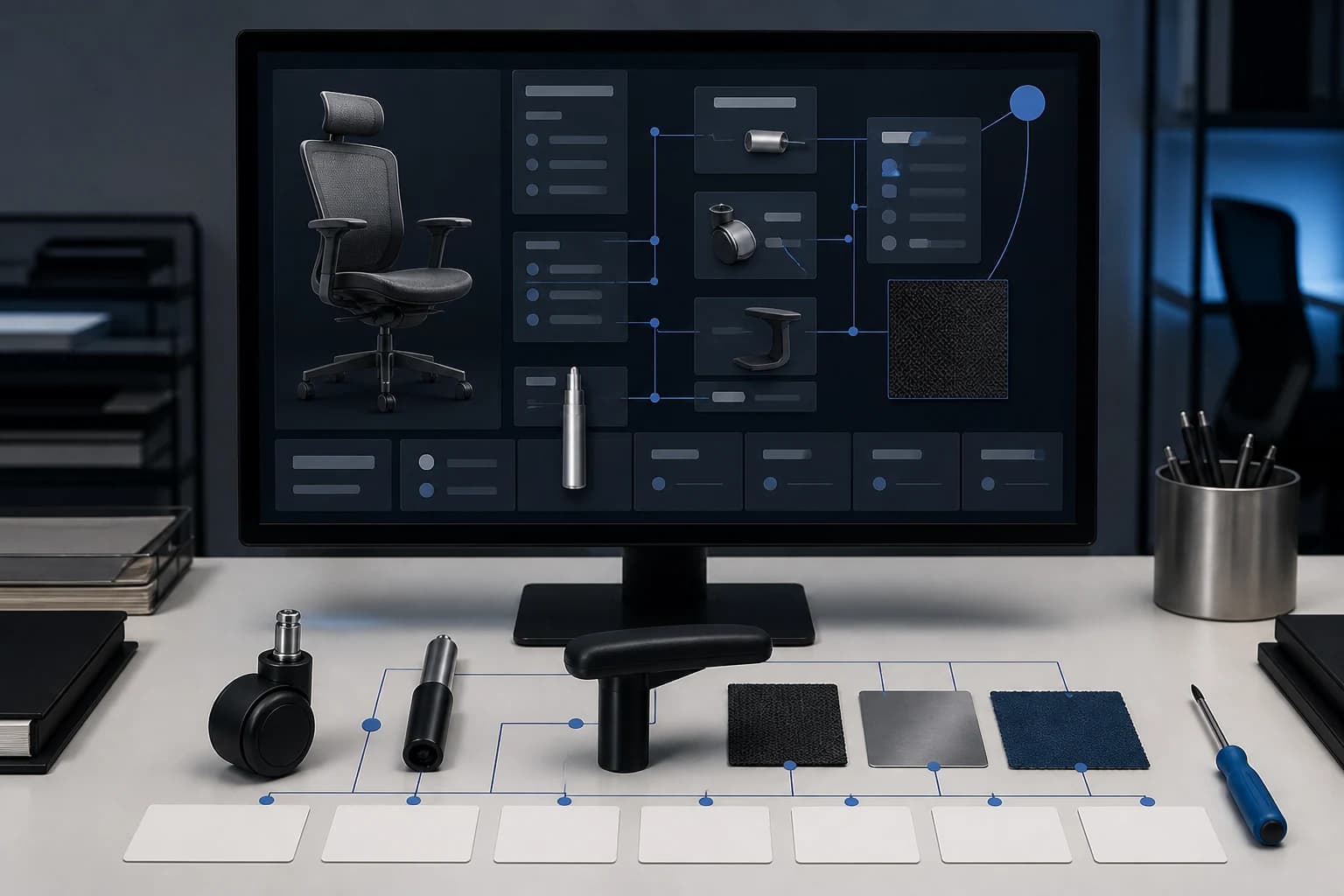
A practical DPP-readiness sequence for an office furniture RFQ
This is readiness work, not a claim that a DPP obligation already applies to every product.
- 1. Map rolesIdentify manufacturer, importer, distributor and the party responsible for maintaining each data field.
- 2. Freeze identityCreate stable model, SKU and configuration identifiers linked to production and commercial records.
- 3. Trace documentationAttach material, component, test and packaging files to exact scopes and revisions.
- 4. Record changeDefine how component, supplier, material or document changes update the product record.
- 5. Check gapsSeparate confirmed data, unavailable data and fields awaiting a final product-specific rule.
- 6. Monitor lawReview official delegated acts, dates and transition rules for the relevant product and market.

What to Check Before You Order
Traceability fields to add to current sourcing briefs
- Exact model, SKU and variant identifier
- Legal manufacturer and actual production location
- Destination market and economic-operator roles
- Material and principal component records
- Test, emissions and declaration files with model coverage
- Packaging composition and labeling data
- Repair, spare-parts and disassembly information where available
- Data owner, document version, expiry and change-control process
Turn traceability expectations into structured RFQ fields
Send the product, destination and required data fields. MENBRO will map available SKU-level records and disclose gaps without presenting readiness work as regulatory certification.
See the MENBRO Showroom and Product Range
Watch a short introduction to MENBRO's office chairs, standing desks, lounge furniture and showroom. Ask our team for the current details of any model you are considering.
Frequently Asked Questions
What happened to the EU Digital Product Passport Registry in July 2026?
The European Commission announced on July 20, 2026 that the Digital Product Passport Registry was live. The registry is infrastructure established under the ESPR to support identifiers and product information for product groups covered by future or applicable ecodesign measures.
Does every office chair already need a Digital Product Passport?
Do not assume that. The registry going live does not by itself create identical immediate requirements for every furniture product. Product-specific delegated acts, coverage, dates, data requirements and economic-operator responsibilities must be checked for the relevant product and market.
Why should furniture suppliers prepare now?
Furniture is identified as a priority product group in the EU's 2025–2030 ESPR working plan. Suppliers can reduce later data gaps by improving model identifiers, material and component records, supplier documentation, manufacturing-location data, repair and spare-parts information, and document version control.
What should an EU furniture buyer request today?
Request an exact SKU and configuration, legal manufacturer and production location, material and component declarations, applicable test or emissions records, packaging data, spare-parts and repair information, and named responsibility for updating documentation. Treat this as readiness work, not proof of a current DPP obligation.
Does MENBRO currently claim an EU DPP for every product?
No. MENBRO does not claim that every catalog product already has an EU Digital Product Passport. Project buyers can state the destination, product and required traceability fields so available data and gaps can be mapped accurately.
References and Further Reading
These references support the product-selection and technical guidance in this article. Product availability and specifications can vary by model and project.
- European Commission: DPP Registry live — Official July 20, 2026 launch announcement.
- ESPR 2025–2030 working plan — Official Commission working plan naming furniture among priority product groups.
- European Commission working-plan overview — Official overview and implementation context.